

In a second appeal, the US Court of Appeals for the Federal Circuit affirmed a district court’s summary judgment of noninfringement based on an implicit ordering of steps in a method claim after disagreeing with the lower court on another basis for noninfringement. Sound View Innovations, LLC v. Hulu, LLC, Case No. 24-1092 (Fed. Cir. Jan. 29, 2026) (Chen, Prost, Wallach, JJ.)
At the district court, Sound View asserted an expired patent against Hulu’s use of a central content server connected to end users through intermediate edge servers. The asserted claim recites downloading streaming content from a buffer in a helper server to an end user while concurrently retrieving more streaming content from a content server.
The district court issued a decision in favor of Hulu, which Sound View appealed. In that first appeal, the Federal Circuit vacated and remanded the district court’s ruling, based on the district court’s negative claim construction.
On remand, the district court determined Hulu did not infringe, finding that the claimed method requires the steps of “receiving a request” and “allocating a buffer” to be performed in sequence. Since Hulu did not perform these claimed steps in order, the district court found there was no infringement. Sound View appealed.
The claim-at-issue recites:
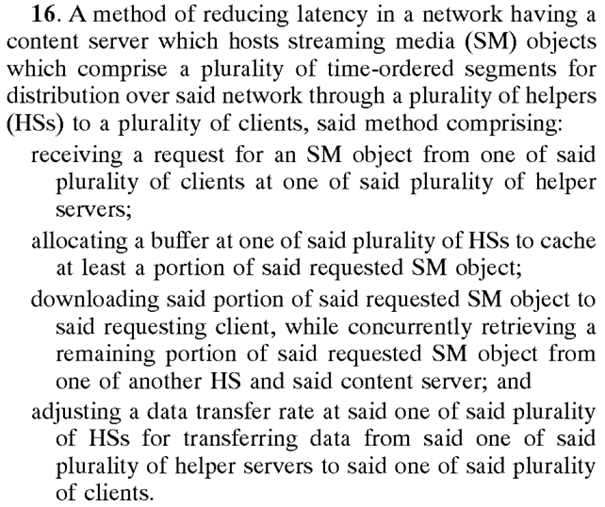
Source: Sound View Innovations, LLC v. Hulu, LLC, Case No. 24-1092 (Fed. Cir. Jan. 29, 2026), Slip Op. at 4.
The Federal Circuit reasoned that the phrase “requested SM object” in the buffer-allocation step grammatically and logically depended on the prior step of “receiving a request,” because an object cannot be “requested” until a request has occurred. The Court explained that “‘requested’ is not only a grammatical descriptor, but also is a status indicator reflecting a completed action – the receiving of a request.”
The Federal Circuit applied precedent on implicit ordering of method steps and noted that “[o]ur caselaw on implicit ordering does not help Sound View, as it does not require a finding that the performance of the claimed steps would be inoperable if the steps are not followed in the order they appear in the claim” (emphasis added). The Court explained that the “logical” dependency between the method steps mandates that the request-receiving step precede buffer allocation. Because there was no dispute that the accused systems performed these steps in a different order, the Court affirmed summary judgment of noninfringement.