
Two January 2026 decisions from the US Court of Appeals for the Ninth Circuit confirm that copyright infringement requires substantial similarity in protectable expression, proven through both extrinsic and intrinsic tests. Yonay v. Paramount Pictures Corp. demonstrates strict application of filtration principles and the constraints of selection-and-arrangement theories at summary judgment. Sedlik v. Von Drachenberg, by contrast, underscores the central and increasingly contested role of the intrinsic test at trial, even when extrinsic similarity evidence is substantial. Yonay v. Paramount Pictures Corp., Case No. 24-2897 (9th Cir. Jan. 2, 2026) (Hurwitz, Miller, Sung, JJ.); Sedlik v. Von Drachenberg, et al., Case No. 24-3367 (9th Cir. Jan. 2, 2026) (Wardlaw, Mendoza Jr., Johnstone, JJ.) (per curiam) (Wardlaw, Johnstone, JJ., concurring).
The extrinsic test examines objective similarities in protectable expression after excluding unprotectable elements while the intrinsic test asks whether an ordinary reasonable observer would perceive substantial similarity in expression without expert guidance.
Yonay v. Paramount Pictures – “Top Guns”
Ehud Yonay authored and owns a copyright in “Top Guns,” a 1983 magazine article about the US Navy Fighter Weapons School, popularly known as “Top Gun.” Yonay sued Paramount Pictures, alleging that its 2022 film Top Gun: Maverick infringed that copyright. The district court granted summary judgment for Paramount, and Yonay appealed.
The Ninth Circuit applied the extrinsic test and rigorously filtered out unprotectable elements, including factual material about the Top Gun program, stock scenes, and high-level themes. The Court concluded that the similarities identified by the plaintiffs existed only at an abstract level and did not involve protectable expression. Although “Top Guns” contains vivid prose and an innovative narrative structure that qualify as protectable expression, none of that expression appeared in the film. The Court explained that even under a selection-and-arrangement theory, courts must filter out unprotectable elements and determine whether the works share a protectable “pattern, synthesis, or design.” After doing so, the Court concluded that the similarities identified by the plaintiffs consisted of unprotectable facts and ideas rather than original expression.
Because the intrinsic test is reserved exclusively for the trier of fact, only the extrinsic test was relevant at the summary judgment stage. The Ninth Circuit also determined that the district court did not abuse its discretion in excluding the plaintiffs’ expert, whose analysis failed to adequately filter out unprotectable elements and therefore relied heavily on similarities in facts and abstract ideas, rendering his opinions unhelpful.
The Ninth Circuit affirmed summary judgment for Paramount, holding that Top Gun: Maverick was not substantially similar to the article “Top Guns.”
Sedlik v. Von Drachenberg, et al. – Miles Davis photograph
Jeffrey Sedlik owns a copyright in his photograph of Miles Davis. Sedlik sued Katherine Von Drachenberg and her tattoo parlor, High Voltage Tattoo, alleging copyright infringement based on Von Drachenberg’s use of the photograph as a reference to create a tattoo depicting Davis’s likeness, the creation of a preliminary sketch, and the posting of related images on social media. After a jury trial, the district court entered judgment in favor of Von Drachenberg and High Voltage Tattoo, and Sedlik appealed.
Sedlik sought review of the district court’s denial of his motion for summary judgment, arguing that the court misapplied the extrinsic test. The Ninth Circuit held that this ruling was not reviewable because it did not present a purely legal question independent of disputed facts.
Sedlik also appealed the denial of his renewed motion for judgment as a matter of law, contending that no reasonable juror could find a lack of substantial similarity. The Ninth Circuit rejected this argument, emphasizing that the intrinsic test is uniquely suited for determination of substantial similarity by the trier of fact due to its focus on the perception of the ordinary observer. Accordingly, the panel declined to disturb the jury’s implicit finding that the challenged works were not intrinsically similar to Sedlik’s photograph.
Because both the extrinsic and intrinsic tests must be satisfied to establish substantial similarity, the jury’s finding on the intrinsic test was dispositive, and the Ninth Circuit panel explained that it did not need to reach the extrinsic test on appeal.
Concurring in the judgment, Judge Wardlaw, joined by Judge Johnstone, criticized the intrinsic test as fundamentally flawed. She argued that the test’s focus on “total concept and feel” conflicts with the Copyright Act’s prohibition on protecting ideas or concepts and invites verdicts unconstrained by copyright doctrine. Judge Johnstone similarly urged the court to realign its substantial similarity analysis with the Copyright Clause, the Copyright Act, and Supreme Court precedent, observing that the intrinsic test has lost meaningful legal content over time.
The accused tattoo art appears on the right, and the allegedly infringed photograph on the left:
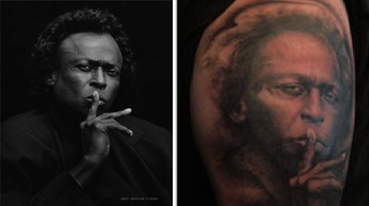
Source: Sedlik v. Von Drachenberg, et al., Case No. 24-3367 (9th Cir. Jan. 2, 2026), Opinion at p. 10.
Practice notes:
The Yonay decision reinforces that at summary judgment, copyright plaintiffs must identify protectable expression or a truly original and protectable selection and arrangement of elements that appears in the accused work. Generalized themes, factual overlap, and abstract similarities will not suffice.
The Sedlik decision confirms that the intrinsic test remains a required component of the Ninth Circuit’s substantial similarity analysis. At trial, a jury’s finding on intrinsic similarity, or lack thereof, can be outcome-determinative, even where objective similarities between works appear significant.