
Results for "Patent infringement"
Subscribe to Results for "Patent infringement"'s Posts

Knowledge of Patent, Evidence of Infringement Are Necessary, but Not Sufficient, to Establish Willfulness

Addressing claim construction, enablement, damages and willfulness, the US Court of Appeals for the Federal Circuit found that evidence of a defendant’s knowledge of the asserted patent and proof of infringement were, by themselves, legally insufficient to support a finding of willfulness. Bayer Healthcare LLC v. Baxalta Inc., Case No. 19-2418 (Fed. Cir. Mar. 1, 2021) (Stoll, J.)

Bayer owns a patent on certain recombinant forms of human factor VII (FVIII), a protein that is critical for blood coagulation. Recombinant FVIII is useful as a treatment for coagulation disorders, primarily Hemophilia A. Natural FVIII has a short half-life, making therapeutic administration expensive and inconvenient. Adding polyethylene glycol (a process known as PEGylating) to FVIII at random sites was found to increase the protein’s half-life but reduce its function. Bayer invented FVIII that is PEGylated in a specific region (the B-domain) so that it retains its function and maintains the longer half-life.

After Baxalta developed a PEGylated FVIII therapeutic, Adynovate®, Bayer sued Baxalta for infringement of its patent. During claim construction, the district court construed the claim preamble “an isolated polypeptide conjugate” to mean “a polypeptide conjugate where conjugation was not random,” finding that Bayer had disclaimed conjugates with random PEGylation. The district court also construed “at the B-domain” to mean “attachment at the B-domain such that the resulting conjugate retains functional FVIII activity,” rejecting Baxalta’s proposal of “at a site that is not any amine or carboxy site in FVIII and is in the B-domain” because Bayer had not disclaimed PEGylation at amine or carboxy sites. Before trial, Baxalta moved for clarification of the term “random” in the construction of the preamble, but the district court “again” rejected Baxalta’s argument that Bayer defined “random” conjugation as “any conjugation at amines or carboxy sites.”

Before trial, Baxalta moved to exclude the testimony of Bayer’s damages expert regarding his proposed reasonable-royalty rate. The expert had defined a bargaining range and proposed to testify that the royalty rate should be the midpoint of the range based on the Nash Bargaining Solution. The district court permitted the expert to testify as to the bargaining range but excluded the opinions regarding the midpoint as insufficiently tied to the facts of the case.

After trial, the district court granted Baxalta’s pre-verdict motion for judgment as a matter of law (JMOL) of no willful infringement. Subsequently, the jury returned a verdict that the claims were infringed and not invalid for non-enablement, and awarded damages based on an approximately 18% royalty rate for the period for which the parties had presented sales information. Baxalta moved for JMOL or a new trial on infringement, enablement and damages. Bayer moved for pre-verdict supplemental damages for the period between the presented sales data and the date of judgment, and for a new trial on the issue of willfulness. The district court denied all of Baxalta’s motions and Bayer’s motion for new trial, but granted Bayer’s motion for supplemental damages, applying the jury’s ~18% rate to sales data for the later period. [...]

Continue Reading


read more
Patent Owner’s Disavowal of Appeal from District Court’s Noninfringement Judgment Moots IPR Appeal

Addressing the standard for mootness in inter partes review (IPR) proceedings following a district court noninfringement judgment, the US Court of Appeals for the Federal Circuit held that a petitioner’s IPR appeal was moot after the patent owner decided not to appeal the final judgment of noninfringement. ABS Global, Inc. v. Cytonome/ST, LLC, Case No. 19-2051 (Fed. Cir., Jan. 6, 2021) (Stoll, J.) (Prost, C.J., dissenting in part).

In June 2017, Cytonome/ST filed a complaint against ABS asserting infringement of six patents, including the patent of interest in this case. ABS filed a petition for IPR of all claims of the patent. In April 2019, the Patent Trial and Appeal Board (PTAB, the Board) issued its final written decision invalidating certain claims of the patent. Two weeks later, the district court granted ABS partial summary judgment, holding that the accused products did not infringe any of the asserted patent’s claims. In June 2019, ABS appealed the PTAB’s final written decision. In a briefing before the Federal Circuit, Cytonome/ST’s counsel filed an affidavit stating that Cytonome/ST “has elected not to pursue an appeal of the district court’s finding of non-infringement as to the patent and hereby disclaims such an appeal.” In June 2020, the district court entered final judgment, including as to non-infringement of the patent.

The Federal Circuit dismissed ABS’ appeal of the PTAB’s final written decision on the ground that the appeal was moot in view of the district court’s non-infringement judgment. The Court characterized the question as one under the voluntary-cessation doctrine. In the context of intellectual property infringement cases, the voluntary-cessation doctrine requires the property owner claiming mootness to prove that the “allegedly wrongful behavior could not reasonably be expected to recur,” i.e., that it will not assert the intellectual property right against the same accused products again. If it does, the burden shifts to the accused infringer to show that it “engages in or has sufficiently concrete plans to engage in activities” that would not be covered by the property owner’s non-assertion decision.

Applying the doctrine, the Federal Circuit concluded that Cytonome/ST could not reasonably be expected to assert infringement of the patent against ABS because ABS had already secured a district court judgment that the accused products do not infringe and Cytonome/ST disclaimed any appeal of the non-infringement judgment. In effect, ABS was insulated from liability for infringement, including for future infringement for products that are “essentially the same” as ABS’ currently accused products pursuant to the Kessler doctrine. Further, the Court found that ABS had not demonstrated it could reasonably expect Cytonome/ST to sue it for infringement of the patent in the future as ABS had not shown it had current or concrete future plans to engage in activities not covered by Cytonome/ST’s disavowal: “Cytonome’s disavowal of its right to appeal the summary judgment of noninfringement ‘estops Cytonome from asserting liability against ABS for infringement of the…patent claims in connection with the accused products, thereby allowing ABS to make, use, and sell those products [...]

Continue Reading


read more

Manufactured host cells markedly different from naturally occurring cells may be patent eligible

Addressing subject matter eligibility in the life sciences context, the US Court of Appeals for the Federal Circuit reversed a district court’s summary judgment ruling that certain claims directed to genetically engineered host cells were patent ineligible as directed to a natural phenomenon. The Federal Circuit found that the claimed cells contained recombinant nucleic acid molecules that were markedly different from anything occurring in nature and therefore were patent eligible under 35 U.S.C. § 101. REGENXBIO Inc. v. Sarepta Therapeutics, Inc., Case No. 24-1408 (Fed. Cir. Feb. 20, 2026) (Dyk, Hughes, Stoll, JJ.)

REGENXBIO owns a patent directed to genetically engineered host cells containing a recombinant nucleic acid molecule (adeno-associated virus (AAV) rh.10 sequences). These host cells are human made and do not exist in nature. The recombinant nucleic acid molecule is created by chemically splicing together nucleic acid sequences from two different organisms. REGENXBIO sued Sarepta, alleging infringement of its patent. Both parties moved for summary judgment on whether the asserted claims were patent eligible under Section 101. The parties did not assert that claims were ineligible as an abstract idea but rather debated whether the claims disclosed natural products.

The district court analogized the claims to those considered in the 1949 Supreme Court decision in Funk Brothers Seed v. Kalo Inoculant, where two strains of bacteria from two different organisms were merely put together. The district court concluded that the invention, “taking ‘two sequences from two different organisms and put[ting] them together,’” amounted to merely packaging natural products together and found the asserted claims ineligible. REGENXBIO appealed.

The Federal Circuit reversed. Relying on the Supreme Court’s decisions in Diamond v. Chakrabarty (1980) and Association for Molecular Pathology v. Myriad Genetics (2013), the Federal Circuit explained that the relevant inquiry was whether the claimed composition as a whole possessed “markedly different characteristics” from what occurs in nature. The Court emphasized that the claimed recombinant nucleic acid molecules were not naturally occurring and cannot form in nature without human intervention. The claims required a recombinant molecule encoding both an AAV vp1 capsid protein and a heterologous sequence, created by combining genetic material from different sources.

The Federal Circuit explained that like the engineered bacterium in Chakrabarty, the claimed host cells here were “not nature’s handiwork” but a product of human ingenuity. And like the cDNA claims upheld in Myriad, the recombinant molecules represented something “distinct from” naturally occurring DNA. In contrast to Funk Brothers, where the bacteria performed exactly as they did in nature and were merely packaged together, the claimed host cells here contained a newly engineered molecule that did not exist in nature and that enabled gene therapy applications.

The Federal Circuit also noted that the claimed compositions had the potential for significant utility, specifically in gene delivery and gene therapy, further distinguishing them from the ineligible claims in Funk Brothers. Although the claims did not expressly recite a specific therapeutic use, the Court explained that potential utility may be considered in evaluating whether a composition is markedly [...]

Continue Reading


read more

Tied up: Federal Circuit affirms antitrust verdict in patent case

The US Court of Appeals for the Federal Circuit affirmed a jury verdict finding that Ingevity engaged in unlawful tying under the Sherman Act by conditioning licenses to its patent on customers’ purchase of its unpatented products that were staple items of commerce. Ingevity Corp. v. BASF Corp., Case No. 24-1577 (Fed. Cir. Feb. 11, 2026) (Lourie, Prost, Cunningham, JJ.)

Ingevity sued BASF for patent infringement. BASF denied infringement, challenged the patent’s validity and enforceability, and asserted counterclaims for unlawful tying under federal antitrust law, alleging that Ingevity conditioned licenses to the patent on customers’ agreement to purchase Ingevity’s unpatented products. The district court granted summary judgment of invalidity and denied motions for summary judgment on BASF’s antitrust claims.

At trial, the jury found that Ingevity unlawfully tied licenses for the patent to sales of its unpatented products and awarded BASF antitrust damages. Ingevity moved for judgment as a matter of law or, alternatively, for a new trial, arguing that its conduct was protected under the Patent Act because its unpatented products were “nonstaple goods” (i.e., goods lacking substantial non-infringing uses) and that its actions were immune under the Noerr-Pennington doctrine. The district court denied those motions, and Ingevity appealed, challenging the jury’s tying liability finding, the rejection of Ingevity’s immunity defenses, and the damages award.

The Federal Circuit first addressed Ingevity’s statutory patent misuse defense under 35 U.S.C. § 271(d), which permits patentees to control nonstaple goods lacking substantial noninfringing uses. The Court concluded that substantial evidence supported the jury’s finding that Ingevity’s unpatented products were staple articles of commerce because the record showed actual and substantial noninfringing uses in air-intake systems. Business records, customer purchases, and technical evidence provided a sufficient basis for the jury to find that the products had recurring, practical noninfringing applications, defeating Ingevity’s reliance on § 271(d).

The Federal Circuit also rejected Ingevity’s immunity arguments. The Court determined that Ingevity forfeited its reframed immunity theory on appeal because it differed materially from the argument presented in the case below. In the alternative, the Court explained that conditioning patent licenses on the purchase of staple goods constitutes commercial tying conduct beyond mere patent enforcement communications and is not protected by either the Patent Act or the Noerr-Pennington doctrine. Accordingly, immunity did not shield Ingevity from antitrust liability.


read more

Here’s an abstract idea: Patent eligibility depends on what is claimed, not unclaimed disclosure

The US Court of Appeals for the Federal Circuit reversed a district court’s rejection of Netflix’s 35 U.S.C. § 101 challenge, finding that claims directed to tailoring content specifications for wireless devices were patent ineligible. GoTV Streaming, LLC v. Netflix, Inc., Case Nos. 24-1669; -1744 (Fed. Cir. Feb. 9, 2026) (Prost, Clevenger, Taranto, JJ.)

GoTV sued Netflix for direct and induced infringement of three related patents directed to server-based tailoring of content for wireless devices. The district court dismissed the induced infringement claims and rejected Netflix’s § 101 challenge. A jury found infringement of one of the asserted patents and awarded $2.5 million in damages. Netflix appealed.

The Federal Circuit reversed the district court’s indefiniteness ruling as to a key term of the representative patents and adopted GoTV’s proposed construction of that claim term: “discrete low level rendering command.” Based on its construction, the Court concluded that the asserted claims were directed to an abstract idea and lacked an inventive concept under Alice. The Court concluded that the claims merely recited the abstract idea of using a generic template tailored to a user’s device constraints and relied on conventional computer and network functions without specifying a concrete technological improvement. The Federal Circuit determined that the claims failed both steps of the Alice framework and were invalid under § 101.

Although its § 101 holding resolved the case in Netflix’s favor, the Federal Circuit vacated the district court’s summary judgment of no inducement and its denial of GoTV’s motion for a new trial on damages, explaining that GoTV had presented substantial arguments on those issues, before directing entry of final judgment for Netflix.

Practice note: The Federal Circuit noted that the ineligibility analysis depends on the claim language at issue, not whether there may be a patent eligible invention disclosed in the specification. Although the prosecution history may be intrinsic evidence for claim construction, recitation of the problems faced by the inventor and the inventive solution cannot be relied on to argue unclaimed details of the invention to render an abstract idea patent eligible.


read more

Relax, design patent claim scope doesn’t include functional elements

Addressing the issue of functional versus ornamental features, the US Court of Appeals for the Federal Circuit affirmed the district court’s summary judgment of noninfringement, concluding that no reasonable juror could find the accused product’s design substantially similar to the patented design once functional features were properly excluded. Range of Motion Prods. v. Armaid Co., Case No. 23-2427 (Fed. Cir. Feb. 2, 2026) (Cunningham, Hughes, JJ.) (Moore, J., dissenting).

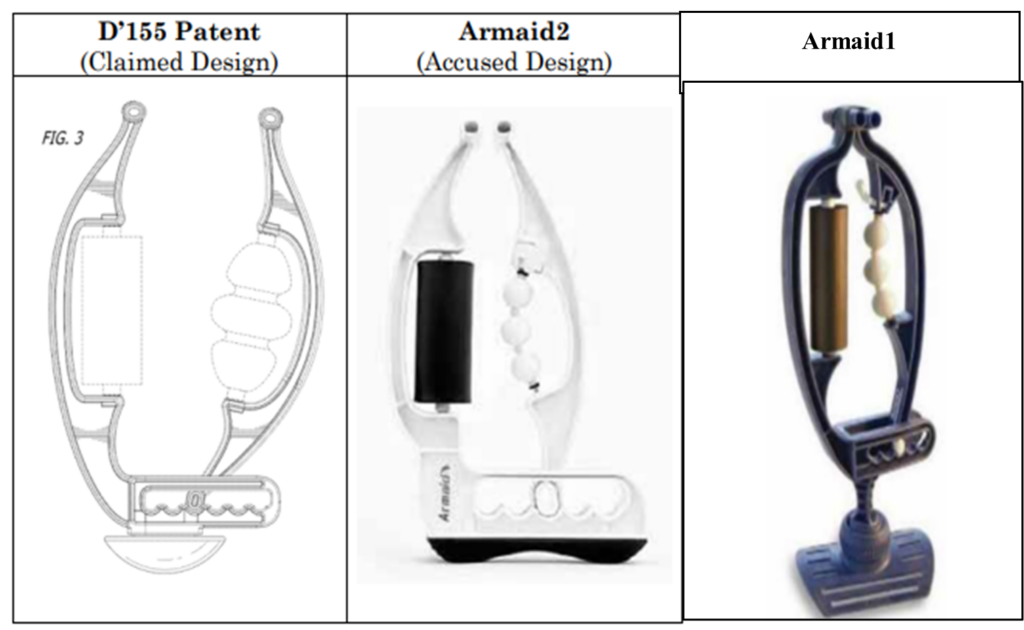
Range of Motion Products (RoM) owns a design patent titled “Body Massaging Apparatus.” RoM sued Armaid Company, alleging that its Armaid2 product infringed RoM’s patent. Armaid owns an expired utility patent (prior art to the RoM patent) titled “Limb Massager” (Armaid1) that embodies elements of the Armaid2 design. The relevant drawings from the product and patents are below.

Source: Range of Motion Prods. v. Armaid Co., Case No. 23-2427 (Fed. Cir. Feb. 2, 2026), Slip Op. at 14.

The district court granted summary judgment in Armaid’s favor, concluding that after properly filtering out functional elements, no reasonable jury could find the Armaid2 design substantially similar to the RoM’s design patent. RoM appealed.

The Federal Circuit reviewed claim construction de novo, the underlying factual findings for clear error, and the summary judgment determination de novo. Applying the ordinary observer test as articulated in Egyptian Goddess, the majority found that several prominent features of the claimed design, most notably the clam shaped arms, were functional. The Court relied on RoM’s own marketing materials, which described the arm shape as providing leverage, and the fact that Armaid’s prior utility patent had claimed similar features.

After excluding those functional elements, the Federal Circuit assessed whether an ordinary observer familiar with the prior art would be deceived into believing the accused design was the same as the patented design based solely on their ornamental aspects. Consistent with post-Egyptian Goddess precedent, the analysis proceeded in two steps: determining whether the designs were “plainly dissimilar,” and if not, comparing the designs in light of the prior art.

The majority concluded that the designs were plainly dissimilar, citing differences in arm shape and the manner in which the fixed arm connects to the hinge. The panel majority further stated that even if the designs were not plainly dissimilar, a comparison against the prior art would yield the same result. The Federal Circuit therefore affirmed summary judgment of noninfringement.

The decision is notable for Chief Judge Moore’s dissent. The dissent argued that both the district court and the majority improperly usurped the jury’s role by resolving what should have been a fact question, which is whether the designs were substantially similar in overall appearance. More broadly, the dissent criticized the Federal Circuit’s evolution of the ordinary observer test, contending that Egyptian Goddess shifted the inquiry away from the Supreme Court’s substantial similarity framework established in Gorham Co. v. [...]

Continue Reading


read more

Can’t patent idea of using asynchronous data streams during web conferencing

The US Court of Appeals for the Federal Circuit affirmed a district court’s dismissal of a patent infringement suit, holding that the asserted web conferencing claims were directed to an abstract idea, lacked any inventive concept, and were therefore not patent eligible under 35 U.S.C. Section 101. US Patent No. 7,679,637 LLC v. Google LLC, Case No. 24-1540 (Fed. Cir. Jan. 22, 2025) (Moore, CJ.; Hughes, Stoll, JJ.)

The patent owner accused Google of infringing a patent that describes systems for web conferencing that allow users to view and manipulate multiple data streams asynchronously, for example by reviewing earlier content while a live presentation continues. The representative claims recited client applications for presenting and observing participants, and some claims recited a server application and a “time scale modification component” to maintain audio quality at different playback speeds. Google moved to dismiss, arguing that the claims were ineligible under Section 101. The district court agreed and denied leave to amend on the rationale of futility. The patent owner appealed.

Reviewing de novo, the Federal Circuit applied the two-step Alice framework. At step one, the Court concluded that the claims were directed to the abstract idea of allowing users to manipulate and review data streams in a web conferencing environment. The Court found that the claims recited desired results, such as asynchronous viewing, without explaining how those results were achieved or identifying any specific technological improvement. The patent owner argued that the claims were not result oriented because they recited two client applications, but the Court found that the claims still failed to describe any technical mechanism for performing the claimed functions.

The patent owner also pointed to alleged “functional claiming” in Google’s own patents, but the Federal Circuit noted that the eligibility of unrelated patents was irrelevant. The Court further rejected the notion that the mere existence of factually distinguishable Google-owned patents somehow amounted to a sweeping concession by Google that all patents involving functional claiming approaches were necessarily patent eligible.

Turning to step two, the Federal Circuit concluded that the claims lacked an inventive concept. The specification described the client applications and the time scale modification component as conventional components performing their ordinary functions. The patent owner largely repeated its step one arguments, which the Court found insufficient to supply an inventive concept.

Finally, the Federal Circuit rejected the patent owner’s argument that dismissal at the pleading stage was premature. Because the asserted patent was ineligible as a matter of law and the patent owner identified no factual allegations that could alter the Section 101 analysis, any amendment would have been futile.


read more

USPTO launches SEP Working Group aimed at strengthening patent enforcement

The United States Patent and Trademark Office (USPTO) announced the formation of the Standard-Essential Patent (SEP) Working Group, which will report directly to USPTO Director John A. Squires. The initiative aims to examine policy issues related to patents incorporated into technical standards and provide guidance on enforcement and licensing practices.

Background

Technical standards underpin many modern technologies, including telecommunications, automotive systems, and artificial intelligence. These standards often include patented technologies, which represent significant investment by inventors. Concerns have emerged about the predictability of remedies and the treatment of patent holders within the SEP ecosystem.

Historically, injunctions in SEP disputes have been difficult to obtain in the United States because SEP patents are typically subject to fair, reasonable, and non-discriminatory (FRAND) commitments. FRAND obligations are intended to ensure broad access to standardized technologies, but they often create uncertainty around enforcement and limit the availability of injunctive relief. This tension has led to debates over whether SEP holders can effectively prevent infringement when licensing negotiations fail.

Recent USPTO actions

The USPTO’s announcement follows its recent involvement in cases addressing patent remedies, in which the USPTO argued that injunctions should be available for SEP patents. In Radian Memory Systems v. Samsung Electronics, the USPTO filed a statement emphasizing the role of injunctions in protecting patent rights. Similarly, in an International Trade Commission investigation involving dynamic random-access memory (DRAM) devices, the USPTO commented on the public interest in enforcing valid patents. Both of these cases involved the assertion of SEP patents.

Objectives of the SEP Working Group

The working group will focus on three areas:

  1. Clarifying enforcement standards: Reviewing approaches to ensure strong and predictable remedies for SEP holders.
  2. Encouraging broader participation: Exploring ways to enable small and medium-sized enterprises to engage in standards development.
  3. Stakeholder engagement and transparency: Creating dialogue with patent holders, implementers, and standards organizations to identify challenges and develop resources for licensing predictability.

USPTO Deputy General Counsel Nicholas Matich and Senior Legal Advisor Austin Mayron will co-chair the working group. The group will seek input from stakeholders across the innovation ecosystem.

Next steps

The USPTO intends for this initiative to formalize its recent policy efforts and provide a structured approach to SEP-related issues. Stakeholders are encouraged to participate in discussions as the group begins its work.


read more

No curtain call yet: Mixed verdict in patent, trademark, standing case

The US Court of Appeals for the Federal Circuit addressed a wide array of issues in a long-running dispute over shower curtain technology. The Court provided important guidance on patent claim scope using intrinsic evidence, trademark standing and ownership of the mark in issue, trade dress functionality under TrafFix, and the need for district courts to provide a reviewable explanation when issuing patent infringement summary judgment based on the facts of this case. Focus Products Grp. Int’l, LLC v. Kartri Sales Co., Inc., Case No. 23-1446 (Fed Cir. Sept. 30, 2025) (Moore, Clevenger, Chen, JJ.)

The decade-long dispute started when Focus Products sent a cease-and-desist letter to Kartri Sales and its supplier, Marquis Mills International. The letter asserted patent infringement but was largely ignored. Focus Products then filed suit asserting three utility patents, two trademarks (HOOKLESS® and EZ ON), and unregistered trade dress rights in the appearance of its shower curtains.

Four months after the Supreme Court’s 2017 decision in TC Heartland v. Kraft Foods Group Brands, Kartri raised a venue objection and filed a motion to dismiss or transfer venue. The district court denied the motion, finding it to be unreasonably late, especially considering that Kartri actively conducted litigation after TC Heartland.

The district court construed several disputed claim terms. Based on its constructions, it found no triable issue of fact and granted summary judgment of patent infringement to Focus Products. However, the district court found genuine disputes of material fact regarding trademark and trade dress infringement and ordered a bench trial on those issues.

On the eve of trial, Kartri asserted unclean hands and equitable estoppel defenses. The district court denied these defenses because they were improperly raised for the first time immediately preceding trial.

After a bench trial, the district court held that:

  • Focus Products had standing to enforce the unregistered EZ ON mark.
  • Kartri infringed the mark and Focus Products’ trade dress, which was determined to be nonfunctional.
  • Kartri infringed Focus Products’ HOOKLESS® mark.

Accordingly, the district court awarded lost profits, reasonable royalties, attorneys’ fees, and enhanced damages for willful infringement. Kartri appealed.

The Federal Circuit affirmed the district court’s denial of Kartri’s motion to transfer venue under TC Heartland, finding Kartri’s objection untimely. Kartri waited four months after TC Heartland to raise the issue, during which time discovery had progressed significantly. The Court emphasized that venue objections must be raised seasonably and that continued litigation in the chosen forum may constitute forfeiture.

The Federal Circuit largely reversed the district court’s infringement findings, explaining that the district court erred in its claim construction because Focus Products had disclaimed shower rings with a flat upper edge during prosecution. While an affirmative disclaimer usually originates from the patent applicant, the Court found clear and unmistakable disavowal through the applicant’s acquiescence to the examiner’s species election, claim cancellation, and narrowed claim scope. This disclaimer was reinforced by the prosecution of a related asserted patent, which explicitly claimed the disclaimed feature. A patentee cannot try [...]

Continue Reading


read more

What we have here is a failure to communicate: Expert must map all claim limitations to the accused infringement

The US Court of Appeals for the Federal Circuit reversed jury verdicts of infringement, finding that they were not supported by substantial evidence because of deficiencies in the patent owner’s expert testimony. Finesse Wireless LLC v. AT&T Mobility LLC, Case No. 2025 WL 2713518 (Fed. Cir. Sept. 24, 2025) (Moore, C.J.; Linn, Cunningham, JJ.)

AT&T Mobility was accused of infringing two patents owned by Finesse Wireless, both directed to methods for mitigating intermodulation product interference in radios. The accused technology involved Nokia radios implementing passive intermodulation (PIM) cancellation. Nokia intervened in the case. A jury found all asserted claims valid and infringed, awarding Finesse more than $166 million in lump sum damages. AT&T and Nokia moved for judgment as a matter of law (JMOL) on both noninfringement and the damages award, and alternatively sought a new trial. The district court denied the motions. AT&T and Nokia appealed.

The Federal Circuit reversed the district court’s denial of JMOL on noninfringement and vacated the damages award, concluding that the jury verdicts were not supported by substantial evidence. The Court’s decision turned largely on shortcomings in the testimony of Finesse’s infringement expert, whose analysis was the sole basis for Finesse’s infringement case.

For the first patent, the Federal Circuit found that Finesse’s expert failed to demonstrate that Nokia’s PIM cancellation feature received all input signals required by the asserted claims. The expert relied on a Nokia diagram but misinterpreted it by mistakenly identifying a signal generated by the radio as one of the required input signals. Although the expert was made aware of the error, he did not clearly correct his position or identify alternative signals that satisfied the claim limitation. Finesse argued that the expert had corrected a “misimpression,” but the Court disagreed, finding that the expert failed to provide a clear and consistent explanation reconciling his contradictory positions.

The asserted claims of the second patent required seven multiplications involving three signals. Finesse’s expert relied solely on a Nokia document that listed only three multiplications yet equated them to the seven required by the claims. The Federal Circuit found this testimony inadequate, noting that the expert failed to explain how the three multiplications mapped to the seven required. On appeal, Finesse argued that the document actually evidenced 10 multiplications, but the Court was unpersuaded. Neither Finesse nor its expert explained how the 10 multiplications corresponded to the seven required multiplications, nor did they reconcile this new position with the expert’s prior reliance on only three multiplications.

Because Finesse failed to present expert testimony that adequately mapped each claim limitation to the accused method, the Federal Circuit reversed the jury’s infringement findings for both patents and vacated the damages award.

Practice note: The decision underscores the importance of detailed and consistent expert analysis in patent infringement cases, particularly when expert testimony is the sole basis for proving infringement.


read more

STAY CONNECTED

TOPICS

ARCHIVES