

 Subscribe
Addressing the issue of functional versus ornamental features, the US Court of Appeals for the Federal Circuit affirmed the district court’s summary judgment of noninfringement, concluding that no reasonable juror could find the accused product’s design substantially similar to the patented design once functional features were properly excluded. Range of Motion Prods. v. Armaid Co., Case No. 23-2427 (Fed. Cir. Feb. 2, 2026) (Cunningham, Hughes, JJ.) (Moore, J., dissenting).
Range of Motion Products (RoM) owns a design patent titled “Body Massaging Apparatus.” RoM sued Armaid Company, alleging that its Armaid2 product infringed RoM’s patent. Armaid owns an expired utility patent (prior art to the RoM patent) titled “Limb Massager” (Armaid1) that embodies elements of the Armaid2 design. The relevant drawings from the product and patents are below.
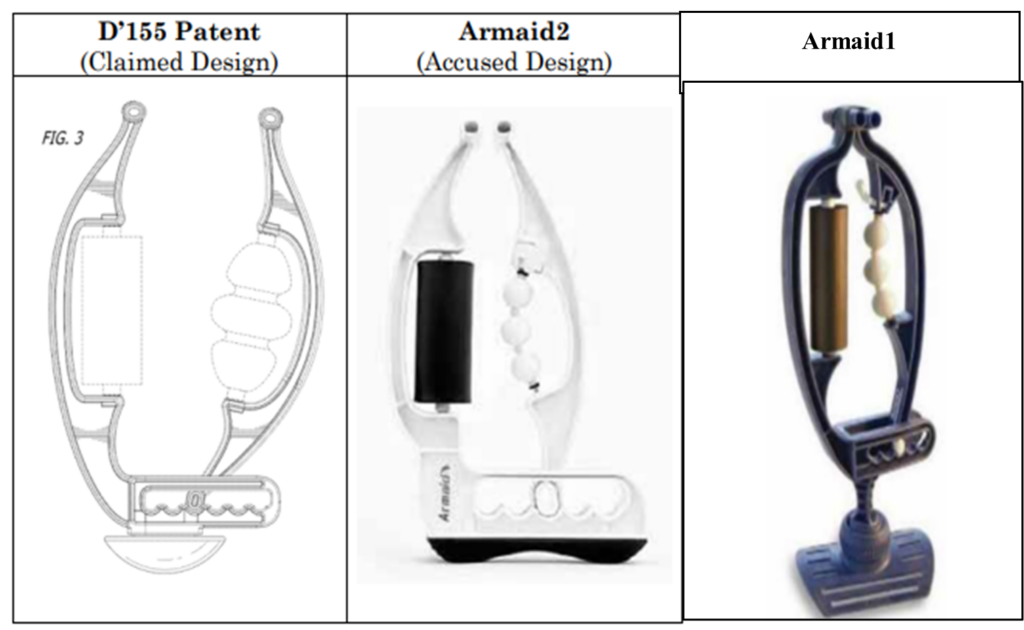
Source: Range of Motion Prods. v. Armaid Co., Case No. 23-2427 (Fed. Cir. Feb. 2, 2026), Slip Op. at 14.
The district court granted summary judgment in Armaid’s favor, concluding that after properly filtering out functional elements, no reasonable jury could find the Armaid2 design substantially similar to the RoM’s design patent. RoM appealed.
The Federal Circuit reviewed claim construction de novo, the underlying factual findings for clear error, and the summary judgment determination de novo. Applying the ordinary observer test as articulated in Egyptian Goddess, the majority found that several prominent features of the claimed design, most notably the clam shaped arms, were functional. The Court relied on RoM’s own marketing materials, which described the arm shape as providing leverage, and the fact that Armaid’s prior utility patent had claimed similar features.
After excluding those functional elements, the Federal Circuit assessed whether an ordinary observer familiar with the prior art would be deceived into believing the accused design was the same as the patented design based solely on their ornamental aspects. Consistent with post-Egyptian Goddess precedent, the analysis proceeded in two steps: determining whether the designs were “plainly dissimilar,” and if not, comparing the designs in light of the prior art.
The majority concluded that the designs were plainly dissimilar, citing differences in arm shape and the manner in which the fixed arm connects to the hinge. The panel majority further stated that even if the designs were not plainly dissimilar, a comparison against the prior art would yield the same result. The Federal Circuit therefore affirmed summary judgment of noninfringement.
The decision is notable for Chief Judge Moore’s dissent. The dissent argued that both the district court and the majority improperly usurped the jury’s role by resolving what should have been a fact question, which is whether the designs were substantially similar in overall appearance. More broadly, the dissent criticized the Federal Circuit’s evolution of the ordinary observer test, contending that Egyptian Goddess shifted the inquiry away from the Supreme Court’s substantial similarity framework established in Gorham Co. v. [...]
Continue Reading
read more