

Sound View Innovations LLC v. Hulu LLC
Subscribe to Sound View Innovations LLC v. Hulu LLC's Posts

Method steps must be done in order where there is logical dependency

In a second appeal, the US Court of Appeals for the Federal Circuit affirmed a district court’s summary judgment of noninfringement based on an implicit ordering of steps in a method claim after disagreeing with the lower court on another basis for noninfringement. Sound View Innovations, LLC v. Hulu, LLC, Case No. 24-1092 (Fed. Cir. Jan. 29, 2026) (Chen, Prost, Wallach, JJ.)

At the district court, Sound View asserted an expired patent against Hulu’s use of a central content server connected to end users through intermediate edge servers. The asserted claim recites downloading streaming content from a buffer in a helper server to an end user while concurrently retrieving more streaming content from a content server.

The district court issued a decision in favor of Hulu, which Sound View appealed. In that first appeal, the Federal Circuit vacated and remanded the district court’s ruling, based on the district court’s negative claim construction.

On remand, the district court determined Hulu did not infringe, finding that the claimed method requires the steps of “receiving a request” and “allocating a buffer” to be performed in sequence. Since Hulu did not perform these claimed steps in order, the district court found there was no infringement. Sound View appealed.

The claim-at-issue recites:
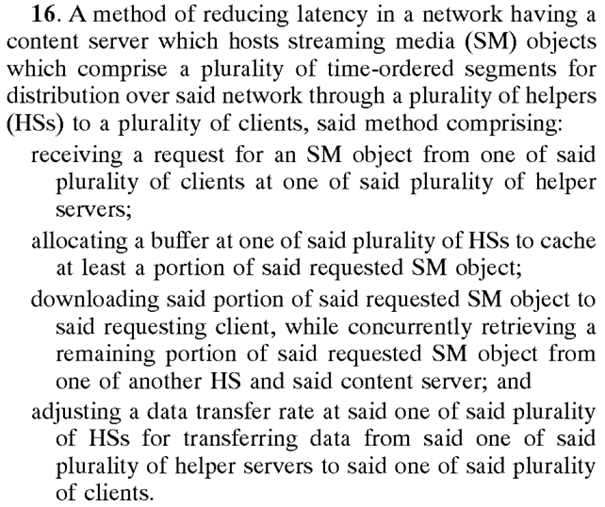
Source: Sound View Innovations, LLC v. Hulu, LLC, Case No. 24-1092 (Fed. Cir. Jan. 29, 2026), Slip Op. at 4.

The Federal Circuit reasoned that the phrase “requested SM object” in the buffer-allocation step grammatically and logically depended on the prior step of “receiving a request,” because an object cannot be “requested” until a request has occurred. The Court explained that “‘requested’ is not only a grammatical descriptor, but also is a status indicator reflecting a completed action – the receiving of a request.”

The Federal Circuit applied precedent on implicit ordering of method steps and noted that “[o]ur caselaw on implicit ordering does not help Sound View, as it does not require a finding that the performance of the claimed steps would be inoperable if the steps are not followed in the order they appear in the claim” (emphasis added). The Court explained that the “logical” dependency between the method steps mandates that the request-receiving step precede buffer allocation. Because there was no dispute that the accused systems performed these steps in a different order, the Court affirmed summary judgment of noninfringement.


read more

Use of Negative Claim Construction is Unsound

The US Court of Appeals for the Federal Circuit vacated a district court’s noninfringement decision that was based on a negative claim construction and remanded with instructions for the district court to determine what affirmative claim construction should be adopted. Sound View Innovations, LLC v. Hulu, LLC, Case No. 21-1998 (Fed. Cir. May 11, 2022) (Prost, Mayer, Taranto, JJ.)

Sound View owns a now-expired patent directed to streaming multimedia information over public networks. Sound View asserted the patent against Hulu based on Hulu’s use of a central content server that’s connected to end users through intermediate edge servers. The asserted claim recites downloading streaming content from a buffer in a helper server to an end user while concurrently retrieving more streaming content from a content server. During claim construction, the district court construed the downloading/retrieving limitation to require using the same buffer, as opposed to two different buffers.

With that claim construction in hand, Hulu sought summary judgment that, in the edge servers of its content delivery networks, no single buffer hosts both the video portion downloaded to the client and the retrieved additional portion. In response, Sound View argued that a factual dispute remained about whether “caches” in the edge servers met the concurrency limitation as construed. The district court held, however, that a “cache” cannot be a “buffer,” and on that basis granted summary judgment of noninfringement. The district court also excluded Sound View’s expert testimony on reasonable royalty damages. Sound View appealed.

The Federal Circuit first reviewed construction of the downloading/retrieving limitation, which was reviewed de novo since the district court relied on only the intrinsic evidence. The Court first analyzed the claim, noting that its wording “reasonably suggests allocating a single buffer” and did not suggest additional buffers. When reviewing the specification, the Court found that it was not inconsistent with reading the claims requiring that the same buffer be used for both downloading and retrieving and observed that it disclosed an embodiment with only one buffer. The Court also reviewed the prosecution history, noting that the applicants added the limitation at issue to distinguish prior art and specifically emphasized the “concurrent[]” limitation. Thus, the Court affirmed the district court’s construction of the downloading/receiving limitation.

Turning to the noninfringement finding, the Federal Circuit rejected the district court’s finding that a “cache” was a different, distinct physical component when compared to a “buffer.” In particular, the Court took issue with this interpretation because it was a negative construction, and the district court never provided an affirmative construction to be used in the infringement analysis. The Court also found that the intrinsic evidence did not support determining that “buffers” and “caches” were mutually exclusive. The Court thus reversed and remanded for the district court to determine an affirmative construction of “buffer.”

The Federal Circuit next addressed the district court’s decision to exclude evidence from Sound View’s expert on reasonable royalty damages. First, the Court determined that the expert could not rely on a study performed in Sydney, Australia [...]

Continue Reading


read more

STAY CONNECTED

TOPICS

ARCHIVES