
Results for "Patent infringement"
Subscribe to Results for "Patent infringement"'s Posts

Hatch-Waxman Litigation Expenses Are Deductible Under Internal Revenue Code § 162(a)

The US Court of Appeals for the Federal Circuit upheld a US Court of Federal Claims ruling that Hatch-Waxman Act litigation expenses are ordinary and necessary business expenses under § 162(a) of the Internal Revenue Code, entitling an abbreviated new drug application (ANDA) filer to deduct litigation expenses incurred defending against a patent infringement lawsuit. Actavis Labs. FL, Inc. v. United States, Case No. 23-1320 (Fed. Cir. Mar. 21, 2025) (Chen, Cunningham, Stark, JJ.)

Actavis filed ANDAs with the US Food and Drug Administration (FDA) seeking approval to market and sell a generic version of a drug already offered for sale in the United States. Per the Hatch-Waxman Act, filing an ANDA is an act of patent infringement where the ANDA holder seeks FDA approval prior to the expiration of the new drug application (NDA) holder’s patent. Following Actavis’s filing, the NDA holder brought a patent infringement lawsuit against Actavis.

Actavis subsequently treated litigation expenses incurred in defending the patent infringement lawsuit as ordinary and necessary expenses. Actavis deducted those litigation expenses on its tax returns for that year. However, the Internal Revenue Service (IRS) considered these expenses to be nondeductible capital expenditures since they were incurred “in pursuit of an intangible capital asset: namely, FDA approval to lawfully market a generic drug product in this country.”

Actavis eventually paid its tax liability but then sued the IRS in the Court of Federal Claims to recover what Actavis considered an overpayment of its taxes. The claims court agreed with Actavis, holding that Hatch-Waxman litigation expenses were deductible as ordinary and necessary business expenses. The IRS appealed.

The Federal Circuit affirmed. When determining whether Hatch-Waxman litigation expenses are deductible under Code § 162(a), the Federal Circuit uses two tests to settle the issue: the “origin of the claim” test and the “most significant benefit” test. However, as the Court emphasized, regardless of which test applied, Actavis prevailed.

The Federal Circuit first explained that Actavis prevailed under either test because patent infringement (not the FDA approval process) is what triggers incurring litigation expenses. Further evidence that the “origin of the claim rests in the patentholder’s decision to sue, and not in the ANDA filer’s decision to seek drug approval from the FDA, is the fact that infringement litigation cannot provide the ANDA filer what it wants – only the FDA can,” the Court stated.

Relying on the Third Circuit’s 2023 decision in Mylan v. Comm’r of Internal Revenue, the Federal Circuit delved into the fairness aspect of allowing Hatch-Waxman litigation expenses to be deductible. Citing Mylan, the Court explained that generic manufacturers defending against patent infringement suits “obtain no rights from a successful outcome. They acquire neither the intangible asset of a patent nor an FDA approval.” The Court also noted that brand-name drug companies in Hatch-Waxman lawsuits may deduct litigation expenses incurred while enforcing their patent rights. “[I]mposing very different tax treatment on the warring sides in an ANDA dispute, as the Commissioner advocates, is at odds with the careful statutory [...]

Continue Reading


read more
Power Play: Pull the Plug on Parallel District Court Litigation, ITC Investigation

The US Court of Appeals for the First Circuit vacated a preliminary injunction, explaining that the district court should have immediately issued a statutory stay of the proceeding under 28 U.S.C. § 1659(a) because a co-pending case at the International Trade Commission involved the same issues and parties. Vicor Corp. v. FII USA Inc., Case No. 24-1620 (1st Cir. Mar. 6, 2025) (Gelpí, Thompson, Rikelman, JJ.)

Vicor filed a § 337 complaint with the Commission against Foxconn asserting power converter module patents while simultaneously suing Foxconn for patent infringement in a Texas district court. Under § 1659, at the request of the party charged in the § 337 complaint, a federal district court must stay proceedings in a civil action between the same parties “with respect to any claim that involves the same issues [as those] involved” in the Commission action. Foxconn successfully secured a stay of the Texas litigation under § 1659.

Foxconn then initiated arbitration in China before the China International Economic and Trade Arbitration Commission (CIETAC), claiming that Vicor had agreed to such arbitration under the terms of their purchase order. The Commission’s administrative law judge denied Foxconn’s request to terminate the § 337 case, finding that Foxconn had waived that defense by failing to timely raise an arbitration defense.

Vicor then sued Foxconn in a Massachusetts district court, disputing any arbitration agreement. The district court issued a temporary restraining order (TRO) and later a preliminary injunction, blocking the CIETAC arbitration. In the Massachusetts litigation, Foxconn sought a § 1659 stay and sought to vacate the TRO. Although the district court agreed that a stay would be permitted, the court rejected the motion to vacate the TRO. The court referenced the All Writs Act, which provides that federal courts “may issue all writs necessary or appropriate in aid of their respective jurisdictions,” as justifying injunctive relief. Foxconn appealed.

The First Circuit agreed that § 1659 applied in the Massachusetts litigation and found that the statute’s plain text required an immediate stay upon Foxconn’s request without granting Vicor a preliminary injunction. The primary issue before the First Circuit was whether Vicor’s claims against Foxconn at the Commission involved the same issues as those in the Massachusetts litigation.

Reviewing the text of § 1659, the First Circuit determined that Vicor’s district court claims in the Massachusetts litigation encompassed the same issues as those raised in the § 337 proceeding. In its Massachusetts litigation, Vicor sought relief under the Federal Arbitration Act to enjoin the CIETAC arbitration and relief under the Declaratory Judgment Act for a ruling that Vicor was not bound by the arbitration terms of the purchase order agreements with Foxconn. Central to both proceedings was Vicor’s argument that it had not agreed to the purchase order terms. Because this issue was common to both the § 337 proceedings and the Massachusetts litigation, the First Circuit determined that the district court needed to issue an immediate stay to Foxconn under § 1659.

Vicor argued that for § 1659 [...]

Continue Reading


read more

CJEU Recognizes Cross-Border Jurisdiction of National Courts, Long-Arm Jurisdiction of UPC

The Court of Justice of the European Union (CJEU) issued a decision significantly expanding the capabilities of both the Unified Patent Court (UPC) and the national courts in EU Member States to issue cross-border injunctions and adjudicate on patent infringement acts in countries (seemingly) outside their respective jurisdiction. Case C-339/22 (CJEU, Grand Chamber Feb. 25, 2025) ECLI:EU:C:2025:108.

Background

German company BSH Hausgeräte GmbH owns a European patent that is validated in several EU Member States and non-EU countries such as Turkey. BSH sued Swedish company Electrolux AB before a Swedish court for infringement of all national parts of the European patent (including the Turkish part).

Electrolux argued that the parts of the patent validated outside Sweden were invalid and that the Swedish court accordingly lacked jurisdiction to rule on these infringement claims. Electrolux relied on Article 24(4) of Regulation (EU) 1215/2012, the Brussels I bis Regulation, which confers exclusive jurisdiction for questions of patent validity on the courts of the state where a patent is registered.

The Swedish court of first instance declared that it did not have jurisdiction to rule on infringement of any non-Swedish parts of the patent. BSH appealed, and the Swedish Court of Appeal referred key questions to the CJEU about the interplay between Articles 4(1) and 24(4) of the Brussels I bis Regulation. Article 4(1) of the Regulation grants the courts of EU Member States general jurisdiction over all infringement actions committed by a person or company domiciled in their territory (regardless of where the infringement occurred). One of the relevant questions in this case was whether, in light of Article 24(4) of the Regulation, the court hearing the patent infringement action loses jurisdiction when an invalidity defense is raised.

Long-Arm Jurisdiction and Invalidity Defense

The CJEU clarified that Article 24(4) of the Regulation must be interpreted narrowly. According to the CJEU, the “validity of patents” mentioned in Article 24(4) of the Regulation only pertains to validity challenges that would lead to the annulment of the patent with effect erga omnes. Such erga omnes validity proceedings must still be brought before the courts of the forum of registration (e.g., the German Federal Patent Court in the case of the German part of a European patent). However, the CJEU considers that Article 24(4) of the Regulation does not apply to an inter partes invalidity defense raised in patent infringement litigation. Consequently, according to Article 4(1) of the Regulation, a court of an EU Member State in which the infringement case is being heard can decide on patent infringements in another EU Member State or in a third (non-EU) country and does not lose its jurisdiction if an invalidity defense is raised. Patent proprietors can therefore obtain cross-border injunctions in national courts of EU Member States (as well as before the UPC, even in states that do not take part in the UPC), and the courts remain jurisdictionally competent even if the infringer imposes an invalidity defense.

Where a third country outside of [...]

Continue Reading


read more

Small-Market Segment Can Still Satisfy Domestic Industry Requirement

The US Court of Appeals for the Federal Circuit affirmed a US International Trade Commission finding, explaining that small-market segments can be significant and substantial enough to support the Commission’s domestic industry requirement. Wuhan Healthgen Biotechnology Corp. v. International Trade Commission, Case No. 23-1389, (Fed. Cir. Feb. 7, 2025) (Moore, Chen, Murphy, JJ.)

Ventria Bioscience Inc. owns a patent directed to cell-culture media, which supplies nutrients to cells grown in artificial environments. Ventria filed a complaint at the Commission alleging that Wuhan Healthgen Biotechnology violated § 337 of the Tariff Act by importing products that infringed the patent. The Commission ultimately found that Healthgen imported infringing products and that Ventria had satisfied the domestic industry requirement. Healthgen appealed.

The Federal Circuit affirmed the Commission’s domestic industry finding. The Court began by explaining the long-standing principle that patent infringement-based violations of § 337, which establishes unlawful import practices, require that “an industry in the United States, relating to the articles protected by the patent…exists or is in the process of being established.” This requirement is divided into economic and technical prongs. Here, Healthgen conceded that the technical prong was satisfied by a Ventria product (Optibumin) that practiced the patent.

The economic prong considers three factors, any of which are sufficient to satisfy the prong. As identified by the subsections of § 337(a)(3), “there is in the United States, with respect to the articles of the patent…(A) significant investment in plant and equipment; (B) significant employment of labor or capital; or (C) substantial investment in its exploitation, including engineering, research and development, or licensing.” The Commission found that each of these factors was met because, among other things, Ventria had 100% of its relevant investments in Optibumin located within the United States. The conclusion was further supported by a comparison of the investments to Obtibumin’s revenue.

Healthgen argued that the investments were too small to be significant or substantial, and that Optibumin’s revenue was low, which inflated investment-to-revenue ratios. The Federal Circuit rejected Healthgen’s argument, stating that “[s]mall market segments can still be significant and substantial enough to satisfy the domestic industry requirement.” The Court continued, stating that a domestic industry analysis “cannot hinge on a threshold dollar value or require a rigid formula; rather, the analysis requires a holistic review of all relevant considerations that is very context dependent.” Here, the Court found that “[t]hough the dollar amounts of Ventria’s Optibumin investments are small, the Commission found all of the investments are domestic, all market activities occur within the United States, and the high investment-to-revenue ratios indicate this is a valuable market.” The Court found that the Commission’s findings were supported by substantial evidence and affirmed the Commission.


read more

Collateral Estoppel Doesn’t Apply to Unchallenged IPR Claims

The US Court Appeals for the Federal Circuit found that despite a Patent Trial & Appeal Board determination that certain challenged patent claims were unpatentable based on a preponderance of the evidence standard, the patent owner is not collaterally estopped from asserting other, unreviewed claims of that patent in district court litigation. Kroy IP Holdings, LLC v. Groupon, Inc., Case No. 23-1359 (Fed. Cir. Feb. 10, 2025) (Prost, Reyna, Taranto JJ.)

Kroy sued Groupon for patent infringement. In response, Groupon filed two inter partes review (IPR) petitions challenging 21 claims of the patent at issue. After Groupon’s IPR deadline passed, Kroy amended its complaint to add additional claims from the challenged patent. The Board found all 21 challenged claims unpatentable. Kroy amended its complaint again, this time removing the 21 unpatentable claims and including only claims that were not at issue in the IPR proceedings.

In response, Groupon moved to dismiss the complaint, arguing that the Board’s prior IPR rulings on the unpatentable claims collaterally estopped Kroy from asserting the new claims. The district court agreed, finding that if the Board issues final judgment that a patent claim is unpatentable and another claim is immaterially different, then collateral estoppel applies to that other claim for purposes of invalidity. Applying that standard, the district court determined that the new claims were not materially different from the unpatentable claims in terms of invalidity and granted Groupon’s motion to dismiss with prejudice. Kroy appealed.

Kroy argued that collateral estoppel should not apply because the burden of proof for invalidity in an IPR proceeding (preponderance of the evidence) is lower than in the district court (clear and convincing). The Federal Circuit noted that this case presents a distinct question of collateral estoppel law; that is, whether a prior final written decision of the Board that certain patent claims are unpatentable precludes a patentee from asserting other claims from the same patent, even assuming the asserted claims are immaterially different from the unpatentable claims for purposes of invalidity.

Referring to its recent 2024 decision in ParkerVision v. Qualcomm, the Federal Circuit clarified that collateral estoppel does not apply to new claims that have not yet been adjudicated. The Court explained that Groupon must prove the invalidity of these new claims in the district court by clear and convincing evidence. The Court dismissed Groupon’s reliance on the 2013 Ohio Willow Wood decision, noting that this case addressed whether a prior district court’s invalidity ruling estopped the patentee from asserting claims in the district court that are immaterially different for purposes of invalidity. On the other hand, the Ohio Willow Wood estoppel scenario occurred in district courts involving the same burden of proof. Because the Board determined unpatentability on separate patent claims based on a preponderance of the evidence standard, courts cannot collaterally estop a patentee from asserting other, unadjudicated patent claims in district court litigation.


read more

For Deterrence: Inherent Power to the Rescue to Punish Meritless Lawsuit

The US Court of Appeals for the Federal Circuit affirmed a district court’s decision to use its inherent power to award deterrence sanctions for filing a nuisance patent infringement lawsuit. PS Products Inc. v. Panther Trading Co. Inc., Case No. 2023-1665 (Fed. Cir. Dec. 6, 2024) (Moore, Stoll, Cunningham, JJ.)

PSP filed a design patent infringement lawsuit against Panther. PSP voluntarily dismissed the case with prejudice after Panther threatened to seek Rule 11 sanctions for the filing of a frivolous lawsuit. After the case was dismissed, Panther filed a motion seeking its attorneys’ fees under 35 U.S.C. § 285 and $100,000 in deterrence sanctions under the court’s inherent power. The district court found the case exceptional under § 285 and awarded Panther its attorneys’ fees. The district court also found PSP and its counsel joint and severally liable for $25,000 in deterrence sanctions. PSP did not appeal the finding that the case was exceptional or the decision to grant attorneys’ fees, but it did appeal the award of deterrence sanctions under the court’s inherent power.

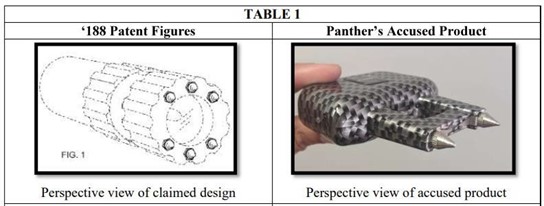
Design patent infringement requires showing that an ordinary observer would find the accused product and claimed design “substantially the same” such that the observer would be deceived into believing that the accused product was the patented design. However, in some cases the accused product and the patented design are “plainly dissimilar” such that it would be clear to an ordinary observer the two designs were not “substantially the same.”

The Federal Circuit affirmed the district court’s award of deterrence sanctions, finding that the district court did not err by inferring PSP’s bad faith conduct based on the clear lack of legal merit of the case against Panther. The Court found that Panther’s accused product was “plainly dissimilar” to the patented design (shown below), such that PSP’s case was a nuisance lawsuit.

The Federal Circuit found that bad faith was also reasonably inferred based on PSP’s history of filing 25 meritless lawsuits in the same district, even though the district court did not analyze each suit. PSP cited the general venue statute in all 25 lawsuits rather than the required patent-specific venue statute, and PSP did not have proper venue in the lawsuit against Panther.

The Federal Circuit also found no abuse of discretion when the district court imposed sanctions under its inherent power. Rule 11 sanctions were unavailable since the case was already dismissed, but the district court had no other mechanism to sanction PSP’s bad faith conduct of filing multiple meritless lawsuits except the court’s inherent power. Finally, the Court found that imposing deterrence sanctions under the district court’s inherent power was proper even when it had already awarded attorneys’ fees and costs under § 285 because the statute does not preclude separate sanctions.

The Federal Circuit declined to award Panther its attorneys’ fees for the appeal because while PSP’s [...]

Continue Reading


read more

Moving to Recuse? Too Little, Too Late

The US Court of Appeals for the Federal Circuit ruled that waiting until well after an adverse summary judgment motion to move for a district court judge’s recusal is untimely and moot, especially where an appeal from the adverse decision is already filed and where the recusal motion is based on public information. Cellspin Soft, Inc. v. Fitbit LLC, et al., Case No. 22-1526 (Fed Cir. Nov. 1, 2024) (Taranto, Prost, Reyna, JJ.) (nonprecedential).

Cellspin filed a complaint for patent infringement against Fitbit and others in October 2017. In February 2021, Fitbit amended its corporate disclosure statement to reflect the completion of its acquisition by Google (an indirect subsidiary of Alphabet). Almost a year later, in January 2022, Fitbit and the other defendants moved for summary judgment of noninfringement in their respective cases, and in June 2022, the district court granted summary judgment.

Months later, in January 2023, after the grant of summary judgment and the filing of notices of appeal from that grant, Cellspin filed a motion to recuse the district court judge based on the judge’s mutual fund investments that were likely to invest in Google. The consulting firm for which the judge’s husband worked also sold Google services, but the judge’s spouse did not do work for Google. The district court denied the motion on the merits as untimely and because the district court lacked authority to vacate the summary judgment that was already on appeal.

Applying Ninth Circuit law and reviewing for abuse of discretion, the Federal Circuit found that Cellspin’s behavior in waiting until well after it had lost on summary judgment, and almost two years after Google’s acquisition of Fitbit became final, “raises obvious concerns of lack of equity and strategic misuse of recusal.” The sources Fitbit cited for the judge’s spouse and the activities of the spouse’s employer were also public well before the summary judgment motion was granted, as were the judge’s financial disclosures.

While there is no specific time limit for seeking recusal, the Federal Circuit (citing its 1989 decision in Polaroid v. Eastman Kodak) noted that “timeliness is a well-established consideration in application of the [recusal] statute. In deciding motions to vacate orders issued by an allegedly disqualified judge, the courts have used ‘untimely’ as a synonym for ‘unfair’ when the circumstances, like those present here, are such that a grant of the motion would produce a result inequitable, unjust, and unfair.”

The Federal Circuit also noted that the risk of injustice to the parties from denying vacatur would also be essentially nonexistent here because the Federal Circuit’s concurrent holding on the summary judgment appeal against other defendants had preclusive effect, resolving Cellspin’s infringement assertions against Fitbit as well.

Practice Note: Any motion for recusal should be promptly filed when grounds for the motion become apparent.


read more

Equivalence Requires Element-by-Element Proof With Linking Argument

The US Court of Appeals for the Federal Circuit affirmed a district court determination that a patent owner had not provided the “particularized testimony and linking argument” required to demonstrate equivalence under the doctrine of equivalents. NexStep, Inc. v. Comcast Cable Commc’ns, LLC, Case No. 2022-1815 (Fed. Cir. Oct. 24, 2024) (Chen, Taranto, JJ.) (Reyna, J., concurring in part and dissenting in part). In his dissent, Judge Reyna criticized the majority for ignoring the totality of the evidence presented by the patent owner and imposing a new rule requiring patentees to always present expert testimony to prove infringement under the doctrine of equivalents.

NexStep owns a patent directed to a “concierge device” for assisting users with obtaining customer support for smart devices. The claims are directed to a concierge device that initiates a technical support session in response to “a single action” (i.e., a single button press) by a user. After the claimed “single action,” the concierge device conveys consumer device identification information for the product at issue, identifies an appropriate technical support team for the product, and causes the home gateway to initiate a support session for the device and forward the consumer device information during the session.

NexStep sued Comcast for patent infringement, asserting that three tools in Comcast’s mobile smartphone application infringed the concierge device patent: Xfinity Assistant, Troubleshooting Card, and Diagnostic Check. Each of these tools assists users with troubleshooting a given device in response to the user pressing a series of buttons on a smartphone’s display. At trial, NexStep argued that pressing a series of buttons literally met the single action limitation because a single action could comprise a series of steps. By way of illustration, NexStep’s expert explained that throwing a baseball – a single action – required multiple steps: “[W]hen you throw a baseball, you pick it up, you orient it, you get it in your palm, you throw it.”

The jury returned a verdict of no literal infringement but found infringement under the doctrine of equivalents. Comcast moved for judgment as a matter of law, which the district court granted after finding that NexStep had failed to offer the “particularized testimony and linking argument” required to demonstrate equivalence. NexStep appealed.

The Federal Circuit emphasized that the doctrine of equivalents provides a “limited exception” to the principle that the claim defines the scope of the patentee’s exclusivity rights, and that a finding under the doctrine of equivalents is “exceptional.” To guard against overbroad applications of this exception, the Court’s precedent imposes specific evidentiary requirements necessary to prove infringement under the doctrine. The patent owner must provide proof on an element-by-element basis and from the perspective of someone skilled in the art, “for example through testimony of experts or others versed in the technology; by documents . . . and . . . by the disclosures of the prior art.” Finally, the patent owner must provide “particularized testimony and linking argument as to the insubstantiality of the differences between the claimed invention and the [...]

Continue Reading


read more

Pre-Markman Claim Construction Is OK, Within Limits

In an appeal stemming from the denial of a preliminary injunction and dismissal of the complaint, the US Court of Appeals for the Federal Circuit clarified its precedent and explained that a district court may construe claims at the motion to dismiss Rule 12(b)(6) stage, but only to the extent necessary to decide the motion. UTTO Inc. v. Metrotech Corp., Case No. 23-1435 (Fed. Cir. Oct. 18, 2024) (Prost, Taranto, Hughes, JJ.)

UTTO sued Metrotech in the US District Court for the Northern District of California for patent infringement and tortious interference with prospective economic advantage under California law. UTTO also moved for a preliminary injunction. The asserted patent describes and claims methods for detecting and identifying “buried assets,” which refers to underground utility lines. The district court denied the preliminary injunction because of UTTO’s failure to show a likelihood of success on the merits for infringement based on the district court’s construction. The district court adopted a construction of the term “group” as requiring at least two data points per buried asset. The district court then dismissed the original complaint for failure to state a claim on which relief could be granted but allowed UTTO to amend, explaining that infringement of the claims as construed at the preliminary injunction stage was not pled.

UTTO then filed an amended complaint, which the district court also dismissed, noting that UTTO failed to plead facts supporting infringement of other limitations under the claim construction issued at the preliminary injunction stage. The district court again granted UTTO leave to amend, which UTTO did. But the district court dismissed that third complaint as well, this time with prejudice, citing the claim construction in its order at the preliminary injunction stage.

On appeal, UTTO (citing 2018 Federal Circuit precedent Nalco v. Chem-Mod) challenged the district court’s claim construction and its reliance on a claim construction in an order denying summary judgment to dismiss a complaint. The Federal Circuit explained that claim construction by a district court “to resolve . . . particular claim construction issues in [a] case” may be necessary and is not categorically barred at the Rule 12(b)(6) stage. The Court explained that there is a “logical relationship of claim construction” between “infringement and the normal function of courts deciding whether to grant a Rule 12(b)(6) motion.” An infringement analysis first requires an analysis of the scope and meaning of the claims asserted and then the “properly construed claims” are compared to the accused device or method. Often, claims are construed based on intrinsic evidence alone, which the Federal Circuit concluded “is not different in kind from the interpretation of other legal standards, which is proper and routine in ruling on a motion under Rule 12(b)(6).” As an example, the Court cited its routine dismissals under Rule 12(b)(6) in connection with motions under 35 U.S.C. § 101.

The Federal Circuit cautioned that not all claim construction issues need to be construed at the Rule 12(b)(6) stage, but only those issues necessary to decide a [...]

Continue Reading


read more

Don’t Tread on Illinois’ Absolute Litigation Privilege

Addressing when Illinois law’s “absolute litigation privilege” bars certain counterclaims, the US Court of Appeals for the Federal Circuit affirmed a district court’s summary judgment finding that the plaintiff lacked a valid trade dress and reversed the district court’s decision that declined to apply the absolute litigation privilege as a complete defense to all of the alleged infringer’s counterclaims. Toyo Tire Corp v. Atturo Tire Corp., Case No. 22-1817 (Fed. Cir. Oct. 4, 2024) (Moore, Clevenger, Chen, JJ.) (nonprecedential).

Toyo and Atturo are competitors in the tire design business. After perceiving widespread copying of its tire designs, Toyo filed a district court action asserting design patent infringement and trade dress infringement against Atturo. Atturo asserted counterclaims, including false designation of origin under the Lanham Act and several state law counterclaims. The district court eventually dismissed with prejudice Toyo’s design patent infringement claims and proceeded with just the trade dress infringement claim.

A primary issue in the case was the description of the asserted trade dress. In its complaint, Toyo identified its trade dress merely as “the overall appearance” of its line of tires. Over the course of discovery, disputes arose concerning Toyo’s failure to distinctly describe its asserted trade dress. Toyo answered an interrogatory that requested this information with a non-limiting definition. The district court compelled Toyo to provide a more specific answer, which Toyo did by providing highlighted images.

Toyo’s fact witness was subsequently deposed under Fed. R. Civ. P. 30(b)(6) and gave answers that were inconsistent with Toyo’s interrogatory response. This led the district court to compel more testimony on what exactly the asserted trade dress contained, and which tire features met the definition of the trade dress, and which did not. On the advice of counsel, the corporate witness declined to answer more than 100 different questions. Toyo’s inability to describe its trade dress continued into expert discovery. When it served its expert reports, Toyo introduced yet another aspect of its trade dress – that the trade dress only included two-dimensional aspects. Toyo introduced this new argument to support the requirement that to qualify as trade dress the designated feature must be nonfunctional.

Atturo moved for sanctions. In granting the sanctions, the district court barred Toyo from asserting only the two-dimensional aspects of the trade dress, precluding Toyo from continually shifting its position because doing so “would effectively lead to trial by ambush.” Having struck the only argument that could save the trade dress from invalidity, the district court granted summary judgment of invalidity on both functionality and lack of secondary meaning.

Trial then proceeded only on Atturo’s counterclaims. The jury returned a verdict in favor of Atturo on six of the counterclaims, awarding $10 million in compensatory damages and $100 million in punitive damages. The district court set aside the jury verdict as it related to counterclaims of defamation and liability under the Illinois Deceptive Trade Practices Act. Both parties appealed.

The Federal Circuit affirmed the district court’s issuance of discovery sanctions, and the grant of [...]

Continue Reading


read more

STAY CONNECTED

TOPICS

ARCHIVES