
Results for "Patent"
Subscribe to Results for "Patent"'s Posts

Patent disclosure erases trade secret protection

Addressing the boundary between patent disclosures and trade secret protection, the US Court of Appeals for the Federal Circuit reversed a jury’s findings of trade secret misappropriation, breach of contract, and improper inventorship, concluding that the asserted “trade secrets” were generally known and therefore not protectable under California law. The Court affirmed, however, a $1 million statutory damages award for trademark counterfeiting. International Medical Devices, Inc. v. Cornell, Case Nos. 25 1580; 1605 (Fed. Cir. Apr. 17, 2026) (Dyk, Reyna, Taranto, JJ.)

International Medical Devices, Menova International, and Dr. James Elist (collectively, the plaintiffs) manufacture and sell the Penuma® cosmetic penile implant. The plaintiffs sued Dr. Robert Cornell and associated individuals and entities after Cornell attended a Penuma® surgical training session under a nondisclosure agreement (NDA) and later helped develop a competing implant. The plaintiffs asserted claims for misappropriation of trade secrets, breach of the NDA, trademark counterfeiting based on unauthorized use of the Penuma® mark, and invalidity of two cosmetic implant patents for failure to name Elist as an inventor.

A jury found for the plaintiffs on all claims. After a bench trial on remedies, the district court awarded more than $17 million in trade secret and exemplary damages, entered a permanent injunction, and awarded $1 million in statutory damages for counterfeiting. Cornell appealed.

The Federal Circuit reversed the trade secret verdict in its entirety, concluding that none of the asserted trade secrets were protectable under California law. The Court concluded that the alleged technical trade secrets were disclosed in publicly available patents and thus were “generally known” as a matter of law.

In doing so, the Federal Circuit reaffirmed the long-standing principle that “that which is disclosed in a patent cannot be a trade secret.” Once information enters the public domain through patent disclosures, it cannot later be reclaimed as confidential business information through trade secret law.

The plaintiffs’ remaining alleged trade secret (a list of surgical instruments) fared no better. The Federal Circuit found that the list had been emailed to the defendants without any confidentiality designation or obligation, defeating any claim that reasonable measures were taken to maintain its secrecy.

Because the plaintiffs failed to identify any confidential information beyond the alleged trade secrets, the Federal Circuit also reversed the breach of contract verdict. The NDA expressly excluded information that was “generally available to the public,” and the Court found that an NDA cannot transform public domain information into protected confidential material.

The Federal Circuit reached a different conclusion on trademark counterfeiting, however, and affirmed the jury’s finding and the $1 million statutory damages award. The Court explained that the evidence showed that Cornell had advertised and offered Penuma® implants without authorization. Cornell argued that the Penuma® mark was registered only for goods, not services, and therefore could not support a counterfeiting claim tied to surgical procedures. The Court rejected that argument, concluding there was sufficient evidence that Cornell offered the Penuma® implant itself as a good, not merely a medical service.

Finally, the Federal Circuit [...]

Continue Reading


read more
Public use, even without explicit public disclosure, is patent bar under pre-AIA § 102(b)

The US Court of Appeals for the Federal Circuit affirmed summary judgment of invalidity under the pre-America Invents Act (AIA) on sale bar, holding that a third party sale to the public of a product embodying a patented method and apparatus can trigger invalidity even where details of the invention were not expressly disclosed. Definitive Holdings v. Powerteq, Case No. 24-1761 (Fed. Cir. Apr. 14, 2026) (Moore, Dyk, Cunningham, JJ.)

Definitive Holdings sued Powerteq alleging infringement of a patent directed to methods and systems for reprogramming engine controllers. With a priority date of March 30, 2001, the patent was subject to pre-AIA law. Powerteq moved for summary judgment of invalidity under pre-AIA 35 U.S.C. § 102(b), arguing that a nonparty, Hypertech, had sold a product (the PP3) that embodied all limitations of the asserted claims more than one year before the patent’s priority date.

Rather than disputing the underlying facts, Definitive challenged the admissibility of the evidence on which Powerteq relied. Definitive argued that the deposition testimony of Hypertech’s Rule 30(b)(6) witness, the PP3 source code, and expert testimony relying on that source code were inadmissible. The district court rejected those arguments and granted summary judgment of invalidity, concluding that the third party sales triggered the on sale bar. Definitive appealed.

The Federal Circuit reviewed the summary judgment ruling de novo, applying Tenth Circuit law.

Definitive first argued that the district court improperly relied on testimony from Hypertech’s Rule 30(b)(6) witness, Hypertech CEO and owner Jay Ramsay. The Federal Circuit disagreed, finding that Ramsay’s testimony was based on his personal knowledge and thus was sufficient to authenticate Hypertech’s sales records and establish that Powerteq’s expert analyzed source code from the PP3 product.

The Court explained that a reasonable juror could conclude that Ramsay had personal knowledge of Hypertech’s recordkeeping practices and sales activities. Because those portions of the testimony were sufficient to support summary judgment, the Court declined to address whether other portions of the 30(b)(6) testimony were properly considered and how the Tenth Circuit generally treats Rule 30(b)(6) testimony at summary judgment.

Definitive next argued that the PP3 source code and related expert testimony constituted inadmissible hearsay. The Federal Circuit disagreed. The Court explained that while comments or annotations in source code could, in some circumstances, qualify as hearsay statements, the operative source code itself functions as a set of commands or instructions. As such, it is not offered for the truth of any assertion. The Court therefore found that the district court did not abuse its discretion in considering expert testimony describing the functioning of the source code when granting summary judgment.

Finally, Definitive contended that the on sale bar did not apply because Hypertech’s sales of the PP3 did not publicly disclose how to perform the patented method, even if the PP3 embodied all claim limitations and was sold more than one year before the priority date.

The Federal Circuit rejected Definitive’s argument, emphasizing that Hypertech’s sales directly conveyed to the public the ability to practice the [...]

Continue Reading


read more

Ticket to ride: USPTO requires counsel for foreign patent applicants

The United States Patent and Trademark Office (USPTO) adopted a final rule requiring foreign-domiciled patent applicants and patent owners to be represented by a registered US patent practitioner, signaling a meaningful procedural shift aimed at harmonization, efficiency, compliance, and fraud prevention. 91 Fed. Reg. 13510 (Mar. 20, 2026).

The USPTO explained that the rule is intended primarily to address recurring compliance and fraud concerns, such as false or improper certifications, including micro entity certifications, and other filings that misrepresent eligibility for fee reductions or expedited treatment. Because registered US practitioners are subject to the USPTO’s Rules of Professional Conduct and disciplinary authority, the agency views mandatory representation as a more reliable accountability mechanism.

The USPTO also cited practical administrative considerations, indicating that foreign pro se filings are more likely to be procedurally deficient and therefore consume disproportionate examination and processing resources, particularly when application papers are not in condition for publication or examination upon receipt.

The final rule clarifies how the requirement will operate in practice. While a foreign domiciled applicant may still obtain a filing date without a practitioner’s signature, any subsequent papers will not be entered unless signed by a registered US patent practitioner. This includes application data sheets, micro entity certifications, petitions, amendments, and other key prosecution documents. In some circumstances, the consequences for noncompliance may be significant. For example, if an unsigned application data sheet is treated merely as a transmittal letter, inventorship, priority, or benefit claims may not be properly established at filing, necessitating corrective petitions and additional cost. Likewise, requests that must be made at filing, such as nonpublication or prioritized examination requests, may be forfeited if not properly signed.

The USPTO emphasized that the rule is procedural rather than substantive. It does not alter the standards of patentability or the requirements for securing a filing date. The rule applies to all filings received on or after its effective date, regardless of the application’s effective filing date. The USPTO also noted that an applicant that believes it has been incorrectly designated as foreign domiciled may respond to that determination even before retaining counsel, although conclusory or unsupported assertions are unlikely to succeed.

Practice note: Foreign applicants and patent owners should now assume that US practitioner involvement is essential to preserve rights and avoid preventable procedural defects.


read more

Manufactured host cells markedly different from naturally occurring cells may be patent eligible

Addressing subject matter eligibility in the life sciences context, the US Court of Appeals for the Federal Circuit reversed a district court’s summary judgment ruling that certain claims directed to genetically engineered host cells were patent ineligible as directed to a natural phenomenon. The Federal Circuit found that the claimed cells contained recombinant nucleic acid molecules that were markedly different from anything occurring in nature and therefore were patent eligible under 35 U.S.C. § 101. REGENXBIO Inc. v. Sarepta Therapeutics, Inc., Case No. 24-1408 (Fed. Cir. Feb. 20, 2026) (Dyk, Hughes, Stoll, JJ.)

REGENXBIO owns a patent directed to genetically engineered host cells containing a recombinant nucleic acid molecule (adeno-associated virus (AAV) rh.10 sequences). These host cells are human made and do not exist in nature. The recombinant nucleic acid molecule is created by chemically splicing together nucleic acid sequences from two different organisms. REGENXBIO sued Sarepta, alleging infringement of its patent. Both parties moved for summary judgment on whether the asserted claims were patent eligible under Section 101. The parties did not assert that claims were ineligible as an abstract idea but rather debated whether the claims disclosed natural products.

The district court analogized the claims to those considered in the 1949 Supreme Court decision in Funk Brothers Seed v. Kalo Inoculant, where two strains of bacteria from two different organisms were merely put together. The district court concluded that the invention, “taking ‘two sequences from two different organisms and put[ting] them together,’” amounted to merely packaging natural products together and found the asserted claims ineligible. REGENXBIO appealed.

The Federal Circuit reversed. Relying on the Supreme Court’s decisions in Diamond v. Chakrabarty (1980) and Association for Molecular Pathology v. Myriad Genetics (2013), the Federal Circuit explained that the relevant inquiry was whether the claimed composition as a whole possessed “markedly different characteristics” from what occurs in nature. The Court emphasized that the claimed recombinant nucleic acid molecules were not naturally occurring and cannot form in nature without human intervention. The claims required a recombinant molecule encoding both an AAV vp1 capsid protein and a heterologous sequence, created by combining genetic material from different sources.

The Federal Circuit explained that like the engineered bacterium in Chakrabarty, the claimed host cells here were “not nature’s handiwork” but a product of human ingenuity. And like the cDNA claims upheld in Myriad, the recombinant molecules represented something “distinct from” naturally occurring DNA. In contrast to Funk Brothers, where the bacteria performed exactly as they did in nature and were merely packaged together, the claimed host cells here contained a newly engineered molecule that did not exist in nature and that enabled gene therapy applications.

The Federal Circuit also noted that the claimed compositions had the potential for significant utility, specifically in gene delivery and gene therapy, further distinguishing them from the ineligible claims in Funk Brothers. Although the claims did not expressly recite a specific therapeutic use, the Court explained that potential utility may be considered in evaluating whether a composition is markedly [...]

Continue Reading


read more

Tied up: Federal Circuit affirms antitrust verdict in patent case

The US Court of Appeals for the Federal Circuit affirmed a jury verdict finding that Ingevity engaged in unlawful tying under the Sherman Act by conditioning licenses to its patent on customers’ purchase of its unpatented products that were staple items of commerce. Ingevity Corp. v. BASF Corp., Case No. 24-1577 (Fed. Cir. Feb. 11, 2026) (Lourie, Prost, Cunningham, JJ.)

Ingevity sued BASF for patent infringement. BASF denied infringement, challenged the patent’s validity and enforceability, and asserted counterclaims for unlawful tying under federal antitrust law, alleging that Ingevity conditioned licenses to the patent on customers’ agreement to purchase Ingevity’s unpatented products. The district court granted summary judgment of invalidity and denied motions for summary judgment on BASF’s antitrust claims.

At trial, the jury found that Ingevity unlawfully tied licenses for the patent to sales of its unpatented products and awarded BASF antitrust damages. Ingevity moved for judgment as a matter of law or, alternatively, for a new trial, arguing that its conduct was protected under the Patent Act because its unpatented products were “nonstaple goods” (i.e., goods lacking substantial non-infringing uses) and that its actions were immune under the Noerr-Pennington doctrine. The district court denied those motions, and Ingevity appealed, challenging the jury’s tying liability finding, the rejection of Ingevity’s immunity defenses, and the damages award.

The Federal Circuit first addressed Ingevity’s statutory patent misuse defense under 35 U.S.C. § 271(d), which permits patentees to control nonstaple goods lacking substantial noninfringing uses. The Court concluded that substantial evidence supported the jury’s finding that Ingevity’s unpatented products were staple articles of commerce because the record showed actual and substantial noninfringing uses in air-intake systems. Business records, customer purchases, and technical evidence provided a sufficient basis for the jury to find that the products had recurring, practical noninfringing applications, defeating Ingevity’s reliance on § 271(d).

The Federal Circuit also rejected Ingevity’s immunity arguments. The Court determined that Ingevity forfeited its reframed immunity theory on appeal because it differed materially from the argument presented in the case below. In the alternative, the Court explained that conditioning patent licenses on the purchase of staple goods constitutes commercial tying conduct beyond mere patent enforcement communications and is not protected by either the Patent Act or the Noerr-Pennington doctrine. Accordingly, immunity did not shield Ingevity from antitrust liability.


read more

Here’s an abstract idea: Patent eligibility depends on what is claimed, not unclaimed disclosure

The US Court of Appeals for the Federal Circuit reversed a district court’s rejection of Netflix’s 35 U.S.C. § 101 challenge, finding that claims directed to tailoring content specifications for wireless devices were patent ineligible. GoTV Streaming, LLC v. Netflix, Inc., Case Nos. 24-1669; -1744 (Fed. Cir. Feb. 9, 2026) (Prost, Clevenger, Taranto, JJ.)

GoTV sued Netflix for direct and induced infringement of three related patents directed to server-based tailoring of content for wireless devices. The district court dismissed the induced infringement claims and rejected Netflix’s § 101 challenge. A jury found infringement of one of the asserted patents and awarded $2.5 million in damages. Netflix appealed.

The Federal Circuit reversed the district court’s indefiniteness ruling as to a key term of the representative patents and adopted GoTV’s proposed construction of that claim term: “discrete low level rendering command.” Based on its construction, the Court concluded that the asserted claims were directed to an abstract idea and lacked an inventive concept under Alice. The Court concluded that the claims merely recited the abstract idea of using a generic template tailored to a user’s device constraints and relied on conventional computer and network functions without specifying a concrete technological improvement. The Federal Circuit determined that the claims failed both steps of the Alice framework and were invalid under § 101.

Although its § 101 holding resolved the case in Netflix’s favor, the Federal Circuit vacated the district court’s summary judgment of no inducement and its denial of GoTV’s motion for a new trial on damages, explaining that GoTV had presented substantial arguments on those issues, before directing entry of final judgment for Netflix.

Practice note: The Federal Circuit noted that the ineligibility analysis depends on the claim language at issue, not whether there may be a patent eligible invention disclosed in the specification. Although the prosecution history may be intrinsic evidence for claim construction, recitation of the problems faced by the inventor and the inventive solution cannot be relied on to argue unclaimed details of the invention to render an abstract idea patent eligible.


read more

Relax, design patent claim scope doesn’t include functional elements

Addressing the issue of functional versus ornamental features, the US Court of Appeals for the Federal Circuit affirmed the district court’s summary judgment of noninfringement, concluding that no reasonable juror could find the accused product’s design substantially similar to the patented design once functional features were properly excluded. Range of Motion Prods. v. Armaid Co., Case No. 23-2427 (Fed. Cir. Feb. 2, 2026) (Cunningham, Hughes, JJ.) (Moore, J., dissenting).

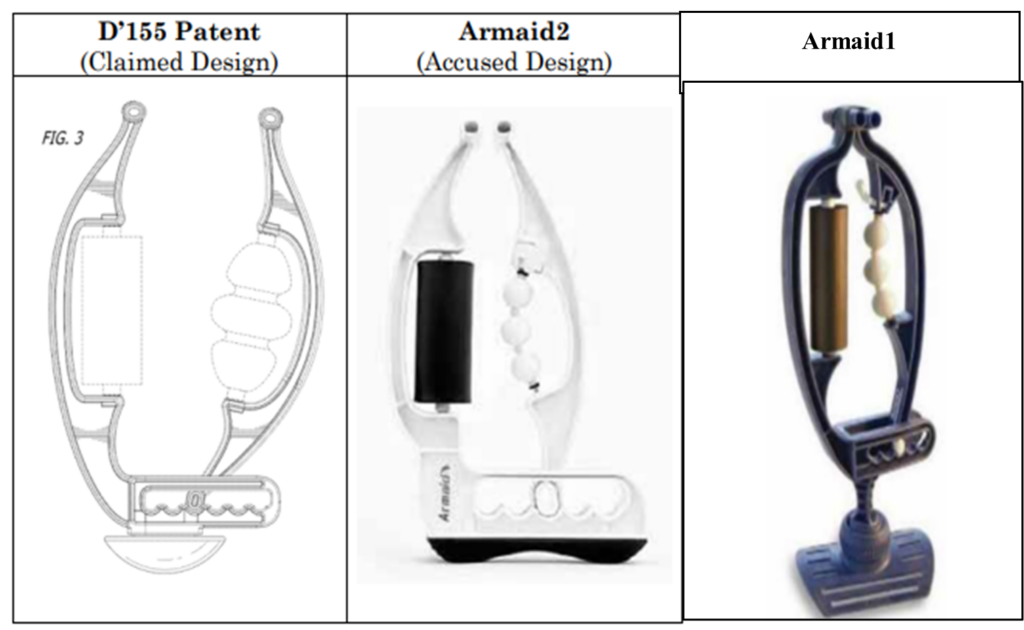
Range of Motion Products (RoM) owns a design patent titled “Body Massaging Apparatus.” RoM sued Armaid Company, alleging that its Armaid2 product infringed RoM’s patent. Armaid owns an expired utility patent (prior art to the RoM patent) titled “Limb Massager” (Armaid1) that embodies elements of the Armaid2 design. The relevant drawings from the product and patents are below.

Source: Range of Motion Prods. v. Armaid Co., Case No. 23-2427 (Fed. Cir. Feb. 2, 2026), Slip Op. at 14.

The district court granted summary judgment in Armaid’s favor, concluding that after properly filtering out functional elements, no reasonable jury could find the Armaid2 design substantially similar to the RoM’s design patent. RoM appealed.

The Federal Circuit reviewed claim construction de novo, the underlying factual findings for clear error, and the summary judgment determination de novo. Applying the ordinary observer test as articulated in Egyptian Goddess, the majority found that several prominent features of the claimed design, most notably the clam shaped arms, were functional. The Court relied on RoM’s own marketing materials, which described the arm shape as providing leverage, and the fact that Armaid’s prior utility patent had claimed similar features.

After excluding those functional elements, the Federal Circuit assessed whether an ordinary observer familiar with the prior art would be deceived into believing the accused design was the same as the patented design based solely on their ornamental aspects. Consistent with post-Egyptian Goddess precedent, the analysis proceeded in two steps: determining whether the designs were “plainly dissimilar,” and if not, comparing the designs in light of the prior art.

The majority concluded that the designs were plainly dissimilar, citing differences in arm shape and the manner in which the fixed arm connects to the hinge. The panel majority further stated that even if the designs were not plainly dissimilar, a comparison against the prior art would yield the same result. The Federal Circuit therefore affirmed summary judgment of noninfringement.

The decision is notable for Chief Judge Moore’s dissent. The dissent argued that both the district court and the majority improperly usurped the jury’s role by resolving what should have been a fact question, which is whether the designs were substantially similar in overall appearance. More broadly, the dissent criticized the Federal Circuit’s evolution of the ordinary observer test, contending that Egyptian Goddess shifted the inquiry away from the Supreme Court’s substantial similarity framework established in Gorham Co. v. [...]

Continue Reading


read more

Can’t patent idea of using asynchronous data streams during web conferencing

The US Court of Appeals for the Federal Circuit affirmed a district court’s dismissal of a patent infringement suit, holding that the asserted web conferencing claims were directed to an abstract idea, lacked any inventive concept, and were therefore not patent eligible under 35 U.S.C. Section 101. US Patent No. 7,679,637 LLC v. Google LLC, Case No. 24-1540 (Fed. Cir. Jan. 22, 2025) (Moore, CJ.; Hughes, Stoll, JJ.)

The patent owner accused Google of infringing a patent that describes systems for web conferencing that allow users to view and manipulate multiple data streams asynchronously, for example by reviewing earlier content while a live presentation continues. The representative claims recited client applications for presenting and observing participants, and some claims recited a server application and a “time scale modification component” to maintain audio quality at different playback speeds. Google moved to dismiss, arguing that the claims were ineligible under Section 101. The district court agreed and denied leave to amend on the rationale of futility. The patent owner appealed.

Reviewing de novo, the Federal Circuit applied the two-step Alice framework. At step one, the Court concluded that the claims were directed to the abstract idea of allowing users to manipulate and review data streams in a web conferencing environment. The Court found that the claims recited desired results, such as asynchronous viewing, without explaining how those results were achieved or identifying any specific technological improvement. The patent owner argued that the claims were not result oriented because they recited two client applications, but the Court found that the claims still failed to describe any technical mechanism for performing the claimed functions.

The patent owner also pointed to alleged “functional claiming” in Google’s own patents, but the Federal Circuit noted that the eligibility of unrelated patents was irrelevant. The Court further rejected the notion that the mere existence of factually distinguishable Google-owned patents somehow amounted to a sweeping concession by Google that all patents involving functional claiming approaches were necessarily patent eligible.

Turning to step two, the Federal Circuit concluded that the claims lacked an inventive concept. The specification described the client applications and the time scale modification component as conventional components performing their ordinary functions. The patent owner largely repeated its step one arguments, which the Court found insufficient to supply an inventive concept.

Finally, the Federal Circuit rejected the patent owner’s argument that dismissal at the pleading stage was premature. Because the asserted patent was ineligible as a matter of law and the patent owner identified no factual allegations that could alter the Section 101 analysis, any amendment would have been futile.


read more

USPTO launches SEP Working Group aimed at strengthening patent enforcement

The United States Patent and Trademark Office (USPTO) announced the formation of the Standard-Essential Patent (SEP) Working Group, which will report directly to USPTO Director John A. Squires. The initiative aims to examine policy issues related to patents incorporated into technical standards and provide guidance on enforcement and licensing practices.

Background

Technical standards underpin many modern technologies, including telecommunications, automotive systems, and artificial intelligence. These standards often include patented technologies, which represent significant investment by inventors. Concerns have emerged about the predictability of remedies and the treatment of patent holders within the SEP ecosystem.

Historically, injunctions in SEP disputes have been difficult to obtain in the United States because SEP patents are typically subject to fair, reasonable, and non-discriminatory (FRAND) commitments. FRAND obligations are intended to ensure broad access to standardized technologies, but they often create uncertainty around enforcement and limit the availability of injunctive relief. This tension has led to debates over whether SEP holders can effectively prevent infringement when licensing negotiations fail.

Recent USPTO actions

The USPTO’s announcement follows its recent involvement in cases addressing patent remedies, in which the USPTO argued that injunctions should be available for SEP patents. In Radian Memory Systems v. Samsung Electronics, the USPTO filed a statement emphasizing the role of injunctions in protecting patent rights. Similarly, in an International Trade Commission investigation involving dynamic random-access memory (DRAM) devices, the USPTO commented on the public interest in enforcing valid patents. Both of these cases involved the assertion of SEP patents.

Objectives of the SEP Working Group

The working group will focus on three areas:

  1. Clarifying enforcement standards: Reviewing approaches to ensure strong and predictable remedies for SEP holders.
  2. Encouraging broader participation: Exploring ways to enable small and medium-sized enterprises to engage in standards development.
  3. Stakeholder engagement and transparency: Creating dialogue with patent holders, implementers, and standards organizations to identify challenges and develop resources for licensing predictability.

USPTO Deputy General Counsel Nicholas Matich and Senior Legal Advisor Austin Mayron will co-chair the working group. The group will seek input from stakeholders across the innovation ecosystem.

Next steps

The USPTO intends for this initiative to formalize its recent policy efforts and provide a structured approach to SEP-related issues. Stakeholders are encouraged to participate in discussions as the group begins its work.


read more

Precedential shift: USPTO clarifies patentability of AI training methods

On November 4, 2025, the Director of the United States Patent and Trademark Office (USPTO) designated as precedential an appeals review panel (ARP) decision vacating the Patent Trial & Appeal Board’s § 101 rejection of claims directed to training machine learning models. Ex parte Desjardins, Appeal No. 24-000567 (ARP Sept. 26, 2025) (precedential).

The Board had previously concluded that claims covering continual learning techniques (such as adjusting model parameters to maintain performance across sequential tasks) were directed to an unpatentable abstract idea. The ARP, which included the USPTO Director, reversed that determination, holding that the claims integrated the abstract concept into a practical application by improving the functioning of machine learning models themselves. However, the ARP still rejected the claims under § 103 for obviousness.

Key takeaways

  • Technical improvements matter. Artificial intelligence (AI)-related inventions can satisfy Alice Step 2A when they demonstrate technical improvements, such as mitigating catastrophic forgetting and reducing storage complexity.
  • No blanket exclusion. The opinion cautions against categorically excluding AI innovations under § 101 and emphasizes that §§ 102, 103, and 112 remain the proper tools for assessing patent scope.
  • Precedential impact. The decision signals the USPTO’s commitment to aligning examination practices with US Court of Appeals for the Federal Circuit precedent while fostering innovation in AI and machine learning.

Practice note: For applicants, this precedential designation underscores the importance of framing AI-related claims around specific technical improvements rather than abstract concepts, which can be pivotal in overcoming § 101 challenges.


read more

STAY CONNECTED

TOPICS

ARCHIVES