
Results for "Patent infringement"
Subscribe to Results for "Patent infringement"'s Posts

District Court Violated Ericsson’s Right to Trial by Jury in Setting FRAND Rate

The US Court of Appeals for the Federal Circuit vacated a district court decision setting license rates for standard-essential patents (SEPs), holding that the district court deprived the patent owner of its constitutional right to trial by jury. TCL Commc’n Tech. Holdings Ltd. v. Telefonaktiebolaget LM Ericsson, Case Nos. 8-1363, -1732 (Fed. Cir., Dec. 5, 2019) (Chen, J.).

Ericsson holds a number of patents that are essential to the 2G, 3G and 4G mobile communications standards set by the European Telecommunications Standards Institute (ETSI). As a member of ETSI, Ericsson has agreed to license its SEPs to implementers of the ETSI standards on fair, reasonable and non-discriminatory (FRAND) terms. TCL manufactures mobile devices that implement the ETSI standards.

(more…)


read more

Federal Circuit Leaves Controversial Noerr-Pennington Trial Court Decision Untouched

The US Court of Appeals for the Federal Circuit denied counterclaim plaintiff’s petition for panel rehearing and rehearing en banc with respect to its decision that the counterclaim plaintiff was estopped from bringing antitrust counterclaims in a patent infringement suit. Intellectual Ventures 1, LLC v. Capital One Financial Corporation, Case No. 18-1367 (Fed. Cir. Dec. 11, 2019) (per curium). In its decision, the Federal Circuit determined that the counterclaim plaintiff could not invoke Tuttle v. Arlington County School Board (4th Cir. 1999) to save its counterclaim and left unaddressed the trial court’s decision with respect to the scope of the Noerr-Pennington doctrine, which was an alternative trial court basis for dismissal of Capital One’s counterclaim.

In its prior decision applying Fourth Circuit law, the Federal Circuit determined that Capital One, the counterclaim plaintiff, could not bring an antitrust counterclaim against Intellectual Ventures based on the doctrine of collateral estoppel. Intellectual Ventures 1, LLC v. Capital One Financial Corporation, (IP Update, Vol. 22, No. 10). In that decision, the Court reviewed Capital One’s appeal of the trial court’s denial of its counterclaims against a prior litigated case in which Capital One’s identical antitrust counterclaim had been denied by the trial court. In bringing its initial appeal, Capital One argued that the antitrust issues related to market definition and Intellectual Ventures’ market power in the initial case were different from the market definition and Intellectual Ventures’ market power issues in the instant case. In its prior decision, the Federal Circuit disagreed and held that the doctrine of collateral estoppel applied as (1) the issues in the instant case was identical to the issues in the prior case; (2) the issues were actually decided in the prior proceeding; (3) the issues were critical and necessary to the judgment in the prior proceeding; (4) the judgment was valid and final; and (5) Capital One had a full and fair opportunity to litigate the issues.

(more…)


read more

Slipping Through the Cracks of the § 271(e)(1) Safe Harbor

The US Court of Appeals for the Federal Circuit affirmed that the majority of the batches of an accused biosimilar manufactured by Hospira were not protected by the Safe Harbor exemption of § 271(e)(1), and that patent infringement damages were not unreasonable, notwithstanding that none of the accused product had been sold. Amgen Inc. v. Hospira, Inc., Case Nos. 19-1067; -1102 (Fed. Cir., Dec. 16, 2019)(Moore, J.).

EPO is a glycoprotein that regulates red blood cell development. Recombinant versions of EPO are used to treat anemia. One example is Amgen’s product Epogen. In 2014, Hospira submitted a Biologics License Application (BLA) to the Food and Drug Administration (FDA) requesting approval for its EPO biosimilar. Amgen then sued Hospira for infringement of its patent directed to methods of producing EPO isoforms and its patent directed to recombinant cells producing EPO at certain rates. Specifically, Amgen asserted that 21 pre-approval batches of EPO manufactured by Hospira infringed various claims of these patents.

Hospira appealed.

(more…)


read more

Garage Door Opener Dispute Highlights Importance of Disavowal

In a pair of opinions, the US Court of Appeals for the Federal Circuit addressed appeals arising out of the Chamberlain Group and One World Technologies’ patent infringement dispute concerning garage door opener technology. In the first appeal of a limited exclusion order issued by the USITC, the Federal Circuit reversed and vacated the USITC’s determination of infringement after finding that it was premised on an incorrect claim construction. Techtronic Industries Co. Ltd. v. Int’l Trade Comm’n, Case No. 18-2191 (Fed. Cir., Dec. 12, 2019) (Lourie, J.). In the second appeal, the Court held the PTAB’s finding that the challenged claims were anticipated was supported by substantial evidence. Chamberlain Group, Inc. v. One World Techs., Inc., Case No. 18-2112 (Fed. Cir., Dec. 17, 2019) (Hughes, J.).

The Chamberlain Group asserted various garage door opener technology patents against One World, including a patent directed to “an interactive learn mode” that assists users in installation and operation of a garage door opener.

(more…)


read more

Method steps must be done in order where there is logical dependency

In a second appeal, the US Court of Appeals for the Federal Circuit affirmed a district court’s summary judgment of noninfringement based on an implicit ordering of steps in a method claim after disagreeing with the lower court on another basis for noninfringement. Sound View Innovations, LLC v. Hulu, LLC, Case No. 24-1092 (Fed. Cir. Jan. 29, 2026) (Chen, Prost, Wallach, JJ.)

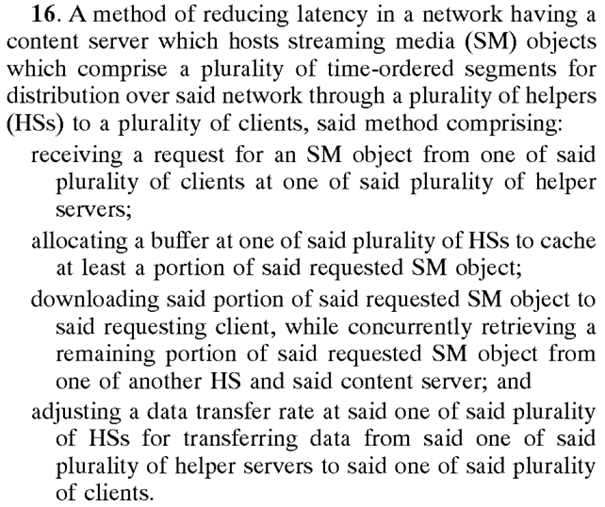
At the district court, Sound View asserted an expired patent against Hulu’s use of a central content server connected to end users through intermediate edge servers. The asserted claim recites downloading streaming content from a buffer in a helper server to an end user while concurrently retrieving more streaming content from a content server.

The district court issued a decision in favor of Hulu, which Sound View appealed. In that first appeal, the Federal Circuit vacated and remanded the district court’s ruling, based on the district court’s negative claim construction.

On remand, the district court determined Hulu did not infringe, finding that the claimed method requires the steps of “receiving a request” and “allocating a buffer” to be performed in sequence. Since Hulu did not perform these claimed steps in order, the district court found there was no infringement. Sound View appealed.

The claim-at-issue recites:

Source: Sound View Innovations, LLC v. Hulu, LLC, Case No. 24-1092 (Fed. Cir. Jan. 29, 2026), Slip Op. at 4.

The Federal Circuit reasoned that the phrase “requested SM object” in the buffer-allocation step grammatically and logically depended on the prior step of “receiving a request,” because an object cannot be “requested” until a request has occurred. The Court explained that “‘requested’ is not only a grammatical descriptor, but also is a status indicator reflecting a completed action – the receiving of a request.”

The Federal Circuit applied precedent on implicit ordering of method steps and noted that “[o]ur caselaw on implicit ordering does not help Sound View, as it does not require a finding that the performance of the claimed steps would be inoperable if the steps are not followed in the order they appear in the claim” (emphasis added). The Court explained that the “logical” dependency between the method steps mandates that the request-receiving step precede buffer allocation. Because there was no dispute that the accused systems performed these steps in a different order, the Court affirmed summary judgment of noninfringement.


read more

Skinny label: Supreme Court to weigh inducement claims against generics

The Supreme Court granted certiorari to review whether a generic drugmaker that fully carves out a patented use from its label can nonetheless be held liable for induced infringement based solely on marketing its product as a generic version of a branded drug and referencing public information about the branded product, without promoting the patented use.

In Amarin Pharma v. Hikma Pharmaceutical USA, Case No. 23-1169 (Fed. Cir. June 25, 2024), the US Court of Appeals for the Federal Circuit concluded that Amarin adequately pleaded induced infringement based on allegations that Hikma marketed its product as a “generic” version of Vascepa and cited publicly available information about Vascepa, even though Hikma’s label carved out the patented indication pursuant to Section viii of the Hatch-Waxman Act.

In its petition to the Supreme Court, Hikma argued that the Federal Circuit’s ruling threatened the statutory balance struck by Hatch-Waxman by exposing skinny-label generic manufacturers to inducement liability based on conduct unrelated to the carved-out use. According to Hikma, permitting inducement claims under these circumstances would effectively nullify Hatch-Waxman Section viii by allowing plaintiffs to rely on generic marketing statements that do not instruct or encourage use of the patented method.

The questions presented are:

  • When a generic drug label fully carves out a patented use, are allegations that the generic drugmaker calls its product a “generic version” and cites public information about the branded drug (e.g., sales) enough to plead induced infringement of the patented use?
  • Does a complaint state a claim for induced infringement of a patented method if it does not allege any instruction or other statement by the defendant that encourages, or even mentions, the patented use?


read more

Hot out of the oven: Trademark limits on pizza-inspired names

The US Court of Appeals for the Seventh Circuit affirmed-in-part and reversed-in-part a preliminary injunction barring the use of PIZZA PUFF, concluding that the trademark owner failed to demonstrate a likelihood of success on the merits because the term was likely generic and, in any event, was descriptively and fairly used. Illinois Tamale Company, Inc. v. LC Trademarks, Inc., Case Nos. 24-3317; 25-1072; -1076; -1112 (7th Cir. Jan. 16, 2026) (Scudder, St. Eve, Jackson-Akiwumi, JJ.)

Illinois Tamale Company (Iltaco), a Chicago-based food company, has sold its signature “Pizza Puff” since 1976, distributing the product nationwide alongside other “Puff”-branded products. Iltaco owns federal trademark registrations for PIZZA PUFF (registered in 2009) and PUFF (registered in 2022).

In March 2024, Little Caesars introduced “Crazy Puffs,” small baked dough cups filled with pizza ingredients. The product launched as part of Little Caesars’ long-running “Crazy” line and was marketed prominently under the Little Caesars name, logo, and orange trade dress. Little Caesars secured its own federal registration for CRAZY PUFFS, and the United States Patent and Trademark Office identified no conflicting marks during examination.

Following the product launch, Iltaco sent a cease-and-desist letter claiming that CRAZY PUFFS and the phrase “4 Hand-Held Pizza Puffs” infringed its trademarks. When Little Caesars declined to change its marketing, Iltaco sued for trademark infringement and unfair competition and sought a preliminary injunction. The district court issued a split ruling, enjoining Little Caesars from using PIZZA PUFF but permitting continued use of CRAZY PUFFS and PUFF. Both parties appealed.

The Seventh Circuit found that the district court applied the wrong legal standard in assessing the protectability of PIZZA PUFF. The Court explained that rather than asking whether competitors could offer similar products without using the term, trademark protectability turns on the “primary significance” test, which is whether consumers primarily understand the term as a brand name or as the common name of a product. Because generic terms can never function as trademarks, the Court focused on evidence of consumer perception.

Applying that framework, the Seventh Circuit found substantial evidence that PIZZA PUFF was generic:

  • More than 80% of surveyed consumers viewed the term as referring to a product category rather than a brand.
  • Dictionary definitions treated the term generically.
  • Third-party filings and industry usage consistently employed the phrase as a common name.

This evidence rebutted the presumption of validity afforded by Iltaco’s federal registration, and Iltaco failed to demonstrate a likelihood of proving distinctiveness at trial. The Court therefore concluded that Iltaco did not show a likelihood of success on the merits and reversed the preliminary injunction barring Little Caesars’ use of PIZZA PUFF.

The Seventh Circuit further found that even if PIZZA PUFF were distinctive, Iltaco still could not obtain injunctive relief because Little Caesars was likely to prevail on a fair-use defense. The Court emphasized that fair use requires only descriptive, good-faith use, and not a perfect fit between the challenged term and the product. Here, PIZZA PUFF plausibly described Little Caesars’ light, pizza-filled food [...]

Continue Reading


read more

Baseball was very good to Roberto: Lanham Act permits claims against government officials in personal capacity

In a decision addressing the intersection of trademark law, sovereign immunity, and constitutional takings, the US Court of Appeals for the First Circuit partially revived Lanham Act claims brought by the heirs of baseball legend Roberto Clemente against senior officials of the Commonwealth of Puerto Rico. While affirming dismissal of claims against the Commonwealth itself and related public entities, the Court concluded that certain Lanham Act claims against individual government officials in their personal capacities were plausibly alleged and not barred by qualified immunity at the pleading stage. Clemente Props., Inc. v. Pierluisi-Urrutia, Case No. 23-1922, 2026 WL 125574 (1st Cir. Jan. 16, 2026) (Barron, Lipez, Thompson, JJ.)

The plaintiffs, Clemente’s sons and affiliated entities, alleged that Commonwealth officials improperly used Clemente’s name and likeness on commemorative license plates and registration tags without authorization. Proceeds from the program were directed toward a public initiative intended to replace an earlier Clemente-founded project. Plaintiffs claimed trademark infringement, false endorsement, false advertising, and dilution under the Lanham Act, as well as a taking in violation of the Fifth and Fourteenth Amendments. Defendants moved to dismiss on immunity grounds and for failure to state a claim. The district court granted the motions in full. Plaintiffs appealed.

The First Circuit reversed in part. The Court rejected the district court’s conclusion that the use of Clemente’s name and image was not “in connection with” goods or services under the Lanham Act. The Court explained that commemorative license plates and tags qualify as goods, and the fact that they were issued by a government entity did not remove them from the statute’s commercial scope. The Court also pointed to the United States Patent and Trademark Office’s Trademark ID Manual, which expressly recognizes license plates as registrable goods, and found no persuasive basis for excluding fundraising activities supporting the Roberto Clemente Sports District Fund from trademark scrutiny.

The First Circuit further concluded that plaintiffs adequately alleged commercial injury within the Lanham Act’s zone of interests and plausibly pleaded likelihood of confusion, including the mistaken impression that the Clemente family endorsed or financially benefited from the initiative. Accordingly, dismissal of Lanham Act claims under Section 32 (trademark infringement), Section 43(a) (false endorsement), and Section 43(c) (dilution) was improper with regard to officials sued in their personal capacities.

Sovereign immunity remained a shield for the Commonwealth, the Convention Center District Authority, and officials sued in their official capacities. However, the First Circuit concluded that qualified immunity did not bar the personal-capacity Lanham Act claims at the pleading stage and thus vacated dismissal and remanded for further proceedings.

The First Circuit affirmed dismissal of the false advertising claim, determining that plaintiffs failed to allege that defendants’ statements constituted commercial advertising or promotion as required under Section 43(a)(1)(B). The Court also affirmed dismissal of the Takings Clause claim, concluding that alleged infringements of intangible intellectual property do not support a categorical physical-taking theory and cannot be analyzed using frameworks applicable to physical occupation or appropriation.

Finally, the First Circuit deemed waived any [...]

Continue Reading


read more

Expert had firm grip on Rule 702

The US Court of Appeals for the Federal Circuit reversed an exclusion of expert testimony and grant of judgment as a matter of law, finding that the district court improperly conflated admissibility with credibility and weight of the evidence. Barry v. DePuy Synthes Companies, et al., Case Nos. 023-2226; -2234 (Fed. Cir. Jan. 20, 2026) (Prost, Taranto, Stark, JJ.) (Prost, J., dissenting).

Mark Barry owns patents covering surgical techniques and tools for treating spinal deformities. Barry sued DePuy alleging that DePuy induced surgeons to infringe the patents. The patents describe tools and methods, including levers, for applying force to vertebrae to realign the spinal column. Two of the patents required the presence of a “handle means,” which the district court construed as “a part that is designed especially to be grasped by the hand.”

At trial, Barry relied on two experts. His infringement expert, Dr. Walid Yassir, testified that DePuy’s accused tools could be assembled and used in infringing configurations and that certain components (or linked assemblies) constituted the claimed “handle means” under the court’s construction. Barry also offered expert testimony from Dr. David Neal, who conducted a surgeon survey to estimate how often DePuy’s tools were used in infringing configurations, which in turn supported Barry’s damages case.

Although the district court had denied DePuy’s pretrial Daubert motions regarding Barry’s experts, it reversed course mid-trial. The court excluded Yassir’s testimony on the ground that he contradicted the court’s claim construction by equating “handle means” with parts that must be grasped during assembly. The court also excluded Neal’s survey testimony, concluding that methodological flaws, such as nonprobability sampling and alleged defects in question design, rendered the survey unreliable. Having excluded both experts, the court granted DePuy judgment as a matter of law. Barry appealed.

The Federal Circuit agreed that expert opinion that contradicts a court’s claim construction would not be helpful to a jury and should be excluded under Rule 702. The Court found, however, that Yassir did not contradict the court’s construction but instead applied it in a manner a reasonable factfinder could accept or reject – a disputed application that DePuy challenged on cross-examination. However, DePuy did not object to Yassir’s direct testimony despite having secured a pretrial ruling barring evidence inconsistent with the claim construction.

The Federal Circuit concluded that Yassir’s testimony did not contradict the court’s claim construction but rather exposed areas of tension and potential weakness in how Yassir applied that construction to the accused devices. The Court explained that DePuy’s questioning elicited testimony about what could constitute a “handle means” that went to the credibility and persuasiveness of Yassir’s opinions, not their admissibility. The Court rejected the district court’s reliance on isolated testimonial snippets divorced from their surrounding explanations, noting that ordinary ambiguities and concessions revealed through adversarial questioning are for the jury to evaluate and do not convert an expert’s application of a claim construction into an impermissible contradiction warranting exclusion under Rule 702.

The Federal Circuit likewise held that the district court abused [...]

Continue Reading


read more

Equivalents still requires all elements be met, injunctive relief still governed by eBay factors

The US Court of Appeals for the Federal Circuit issued a mixed ruling in a dispute over patents covering child car seat technology, explaining that infringement under the doctrine of equivalents requires an equivalent for each and every claim element, and that a grant of injunctive relief requires proof of all eBay factors. On the issue of willfulness, the panel majority held that the exclusion of exculpatory evidence was a reversable error. Wonderland Switzerland AG v. Evenflo Co., Inc., Case Nos. 23-2043; -2233; -2326 (Fed. Cir. Dec. 17, 2025) (Moore, Prost, JJ.) (Reyna, J., concurring in part and dissenting in part).

Wonderland owns two patents directed to convertible child car seats. Wonderland alleged that Evenflo’s four-in-one convertible seat models infringed its patents. A jury found infringement of one patent under the doctrine of equivalents and infringement of the other patent both literally and under the doctrine of equivalents. The district court entered judgment and permanently enjoined Evenflo from activities related to both patents. Evenflo appealed.

Evenflo challenged the finding of infringement under the doctrine of equivalents for the first patent, arguing that its accused seats lacked the claimed “locking mechanism for selectively detachably connecting” the seat back to the seat assembly. The Federal Circuit agreed, finding that no reasonable jury could find equivalence because the claim “plainly requires the seat back to include the components for selective detachability,” whereas Evenflo’s seats “simply include a stationary metal bar” and all locking components reside on the seat assembly. As a result, the Court concluded “there c[ould] be no equivalence as a matter of law.”

Evenflo also argued that the district court abused its discretion in permanently enjoining activities relating to both patents. Regarding the first patent, the Federal Circuit found that the district court abused its discretion in granting a permanent injunction because Wonderland expressly declined to request such relief. Wonderland argued the grant of a permanent injunction as to the first patent was harmless error because it had the same “practical effects” as the injunction for the second patent. The Court disagreed, explaining that the injunction could affect Evenflo’s release of other products, which may not necessarily infringe the second patent.

Regarding the second patent, the Federal Circuit concluded that the district court abused its discretion in granting a permanent injunction because it relied solely on speculative and conclusory evidence that Wonderland suffered, and would continue to suffer, irreparable harm or injury that could not be compensated with monetary damages. The Court explained that the district court failed to identify evidence that Wonderland’s partner lost sales or market share to Evenflo rather than other competitors, or that the partner’s reputation or product distinctiveness was harmed. The Court also noted that testimony that a lost car seat sale “naturally leads” to loss of other product sales was based on conjecture without supporting data. Finally, the Court found that statements that consumers “might think” technology problems existed if Evenflo’s product failed were deemed speculative and insufficient to establish irreparable harm.

Wonderland cross-appealed, asserting [...]

Continue Reading


read more

STAY CONNECTED

TOPICS

ARCHIVES