
Results for "Trademark appeal"
Subscribe to Results for "Trademark appeal"'s Posts

Hairy Situation: Trademark Act Doesn’t Provide Consumer Standing

The US Patent & Trademark Office Trademark Trial & Appeal Board found that a consumer did not have standing to oppose an application for registration because the consumer failed to establish a commercial interest and injury that would be proximately caused by the registration of the mark. Rebecca Curtin v. United Trademark Holdings, Inc. (TTAB May 4, 2023) (Adlin, Lynch, Bunn, ATJs.)

Rebecca Curtin, a trademark law professor, has purchased various toys for her daughter. Curtin filed an opposition to United Trademark Holdings’ (UTH) application to register RAPUNZEL for use in connection with “dolls; toy figures.” Curtin alleged that RAPUNZEL fails to function as a trademark and is generic (or merely descriptive) of the identified goods and that UTH committed fraud. Curtin lamented that competition would be impeded if “private companies are allowed ‘to trademark the name of a famous fairytale character in the public domain,’” which would likely force consumers to pay higher prices for the relevant goods. Curtin also stated that allowing this registration “could chill the creation of new dolls and toys by fans of the Rapunzel fairytale, crowding out the substantial social benefit of having diverse interpreters of the fairytale’s legacy.”

More than four years ago, the Board denied UTH’s motion to dismiss, finding that Curtin had standing by relying on a case from 1999 that addressed the Trademark Act’s bar to registration for “immoral” or “scandalous” marks. Months after the Board’s initial decision, however, the Supreme Court ruled in Iancu v. Brunetti that the portion of the Trademark Act barring registration for “immoral” or “scandalous” marks was unconstitutional, and updates were issued on the “standard for determining whether a party is eligible to bring a statutory cause of action.”

A plaintiff has standing to oppose registration of a mark “when doing so is within the zone of interests protected by the statute and [opposer] has a reasonable belief in damage that would be proximately caused by registration of the mark.” Here, the Board explained that the statute at issue was the Trademark Act, which identifies its interest as regulating commerce and protecting plaintiffs with commercial interests: “[A] mere consumer that buys goods or services is not under the Trademark Act’s aegis.”

Moreover, Curtin failed to demonstrate that an injury would result from registration of the mark. The Board was unconvinced by Curtin’s explanations of the potential harm to competition and resulting higher prices for consumers, stating that the “allegations of damage are [] too remote, because the alleged damage to Opposer depends first on the alleged effect of registration on other commercial doll markets or sellers.” The Board, therefore, dismissed the opposition.


read more

Elevate the $: Geographic Isolation Helps Defeat Trademark Infringement Claim

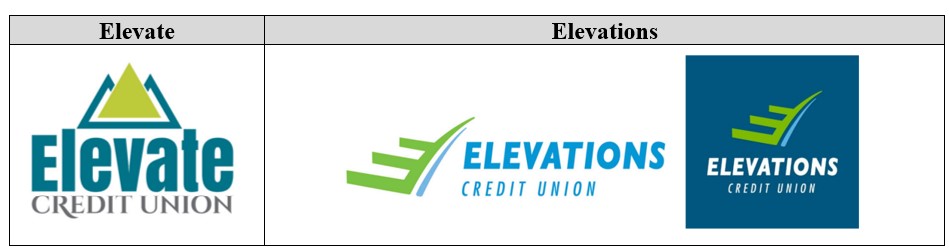
In a case between similarly named banks, the US Court of Appeals for the Tenth Circuit confirmed expert disclosure requirements, conducted a de novo likelihood of confusion analysis and ultimately upheld a finding of no trademark infringement. Elevate Federal Credit Union v. Elevations Credit Union, Case No. 22-4029 (10th Cir. May 10, 2023) (Bacharach, Moritz, Rossman, JJ.)

Elevate is a federal credit union with almost 13,000 total members, operating exclusively in three rural Utah counties. Elevations is a Colorado state-chartered credit union with more than 150,000 members. The parties’ respective logos are shown below:

Elevate filed a suit seeking declaratory judgment of noninfringement, and Elevations counterclaimed for trademark infringement. After excluding testimony from Elevations’s expert, the district court found no infringement and granted summary judgment in favor of Elevate. Elevations appealed.

Elevations raised two issues on appeal:

  1. Did the district court abuse its discretion in excluding Elevations’s expert’s testimony?
  2. Did the district court err in granting summary judgment to Elevate on likelihood of confusion?

The Tenth Circuit affirmed the district court on the first issue. Elevations’s expert conducted a survey that involved showing marks from internet searches to consumers and asking whether they thought any came from the same company. While this survey type is legitimate, the expert did not keep records of his searches, write down his search terms, identify his search engines, or justify why he conducted multiple internet searches but showed consumers only results from Bing and the Apple App store. The Tenth Circuit found that the district court could have reasonably considered this information “facts or data” considered by the expert that needed to be—but was not—disclosed. Because the expert failed to meet his disclosure obligations and because this failure was not excused by justification or harmlessness, the lower court did not abuse its discretion.

The Tenth Circuit also affirmed the summary judgment of no likelihood of confusion. The Court conducted a de novo review and analyzed the six factors below. The Court concluded that the following five factors weighed against the likelihood of confusion:

  1. Level of care exercised by purchasers. When customers look to open bank accounts or borrow money, they exercise a great level of care. This is especially true here because credit unions have statutory membership restrictions, meaning consumers need to confirm they qualify for membership before applying.
  2. Strength of senior mark. While Elevations’s marks are “suggestive” and therefore “fall[] midway in the range of conceptual strength,” many other businesses in Colorado use the root term “elevat,” which weakens Elevations’s mark. Elevations’s marks also are weak where Elevate operates in Utah due to lack of advertising.
  3. Degree of similarity. While the marks have some similarities in appearance and sound, they differ in fonts, alignment, background colors, graphics and number of syllables. The Court also stated that the “significance of the similarities fades away” in light [...]

    Continue Reading


read more

Pending Appeal Does Not Divest Board of Statutory Authority to Institute IPRs

In a case involving sua sponte review, the Director of the US Patent & Trademark Office (PTO) vacated an inter partes review (IPR) decision denying institution, found that the Patent Trial & Appeal Board had statutory authority to institute IPR review of a claim that had been previously found invalid by a district court under 35 U.S.C. § 101 (but under appeal), and remanded the proceeding for the Board to consider whether discretionary denial was appropriate. Volvo Penta of the Americas, LLC v. Brunswick Corp., IPR2022-01366, -01367, -01368, -01369, -01424 (PTO May 2, 2023) (Vidal, Dir.).

Brunswick owns several patents related to marine vessels. Volvo filed IPR petitions challenging the patents, which the Board ultimately denied. Prior to the Board’s decision, the District Court for the Eastern District of Virginia determined that claim 1 in each of the challenged patents was directed to patent-ineligible subject matter and thus was invalid under § 101. In denying institution, the Board concluded that it lacked authority to institute the IPRs because the challenged claims were no longer in effect and the America Invents Act (AIA) only permits a petitioner to challenge a claim, noting that “when given its plain and ordinary meaning, § 311(b) provides that only claims that are in effect may be annulled.” Although Brunswick appealed the district court’s decision, the Board determined that the challenged claims were finally adjudicated. Thus, the Board lacked authority to institute the requested IPR. The Board also determined that the multi-factor Fintiv analysis for discretionary denial under 35 U.S.C. § 214(a) was inapplicable here in view of the district court’s invalidity finding.

The Director reviewed the Board’s decision sua sponte and vacated the Board’s institution decision with instructions to analyze Fintiv factors 1 through 5 in view of the parallel district court proceeding.

The Director first addressed the Board’s § 311(b) analysis. The Director concluded that in finding the district court’s invalidity determination to be a final adjudication, the Board appeared to have borrowed from collateral estoppel principles. The Director found, however, that these principles do not apply to § 311(b) nor was there any assertion that Volvo was collaterally estopped from pursuing IPRs. The Director also determined that the challenged claims were not fully adjudicated since the district court’s decision was subject to further judicial review. Thus, the Director found that the Board had statutory authority to institute the IPRs.

Next, the Director addressed the Board’s Fintiv analysis, finding that the Board improperly interpreted Fintiv as limited to its exercise of discretion in the context of ongoing parallel district court litigation where final judgment has not yet been entered. The Director explained that the Fintiv analysis applied where, as here, the claims remain subject to further review on appeal. The Director instructed the Board to evaluate the Fintiv factors on remand and instructed that if the Board determines that these factors favor discretion to deny institution, the Board should then consider whether the case on the merits is compelling (consistent with the
Continue Reading


read more

And All That Jazz: Trademark Used for One Service Doesn’t Permit Tacking for Others

Reversing the Trademark Trial & Appeal Board’s decision to dismiss an opposition, the US Court of Appeals for the Federal Circuit addressed the requirements for a trademark owner to employ “tacking” based on the use of a mark for one service in the context of a trademark application listing multiple services. Bertini v. Apple Inc., Case No. 21-2301 (Fed. Cir. Apr. 4, 2023) (Moore, C.J.; Taranto, Chen, JJ.)

Charles Bertini is a professional jazz musician who filed a notice of opposition to Apple’s application to register the mark APPLE MUSIC. Because the parties did not dispute that there was a likelihood of confusion between the two marks, the only disputed issue was which party’s mark was entitled to an earlier priority date. Bertini’s mark, APPLE JAZZ, had a priority date of June 13, 1985, for use in live music festivals and concerts. Apple’s mark, APPLE MUSIC, which was the subject of the opposition, had a priority date of June 8, 2015. In its application, Apple sought to register its mark for 15 broad service categories, including the production and distribution of sound recordings and the arranging, organizing, conducting and presenting of live musical performances.

Because Bertini’s mark had the earlier priority date, Apple attempted to use tacking to claim an earlier priority date to an APPLE mark used by Apple Corps. for gramophone records featuring music since August 1968. Apple purchased this mark from the Beatles’ Apple Corps. in 2007. Tacking allows a trademark owner to give a newly modified mark the priority date of its old mark, but only if both marks “create the same, continuing commercial impression so that consumers consider both as the same mark.” The Board found that Apple was entitled to tack back to use the 1968 date of use of the APPLE MUSIC mark and thus had priority over Bertini. The Board accordingly dismissed Bertini’s opposition. Bertini appealed.

The Federal Circuit first addressed the tacking standard in the context of trademark registration. The Court explained that in order to obtain an earlier priority date through tacking, an applicant must show that the old mark was associated with all of the goods and/or services listed in its application as of the proposed earlier priority date. The Court found that Apple failed to meet this burden. As of 1968, the APPLE mark was not associated with the service of “arranging, organizing, conducting, and presenting live musical performances.” Because this service was listed in Apple’s trademark application, the APPLE MUSIC mark application was not entitled to claim priority back to the priority date of the Apple Corps. APPLE mark. The Court noted that Bertini only needed to show priority of use of APPLE JAZZ for any service listed in Apple’s application to succeed in his opposition. Because the Court rejected Apple’s attempt to tack back to the 1968 priority date for all of Apple’s listed services where Apple could only show priority for one service listed in its application, Bertini met this burden. The Court also concluded [...]

Continue Reading


read more

Charter Schools Aren’t Immune from Trademark Suits

The US Court of Appeals for the Fifth Circuit affirmed a district court’s dismissal of a trademark suit against a charter school operator and public school district in Texas but explained that the charter school was not automatically immune from lawsuits based on sovereign immunity. Springboards to Education, Inc. v. McAllen Indep. School District, Case Nos. 21-40333; -40334 (5th Cir. Mar. 8, 2023) (Smith, Duncan, JJ.) (Oldham, J., concurring).

Springboards sells products to school districts in connection with its Read a Million Words Campaign. The campaign incentivizes school children to read books through promises of induction into the Millionaires’ Reading Club and access to rewards such as t-shirts, backpacks and fake money. Springboards’s goods typically bear any combination of trademarks that the company registered with the US Patent & Trademark Office, including “Read a Million Words,” “Million Dollar Reader,” “Millionaire Reader” and “Millionaires’ Reading Club.”

Springboards filed a complaint for trademark infringement, trademark counterfeiting and false designation of origin against McAllen Independent School District (MISD), a public school district in Texas, and IDEA Public Schools, a nonprofit organization operating charter schools in Texas. Both MISD an IDEA moved to dismiss for lack of subject matter jurisdiction, arguing that they were arms of the state and thus entitled to sovereign immunity. They also moved for summary judgment for lack of infringement. The district court ruled that only IDEA enjoyed sovereign immunity and accordingly granted IDEA’s motion to dismiss but denied MISD’s. The district court granted MISD’s motion for summary judgment after concluding that Springboards could not establish that MISD’s program was likely to cause confusion with Springboards’s trademarks. Springboards appealed.

The Fifth Circuit began with the jurisdictional issue of whether IDEA and MISD enjoyed sovereign immunity. The Court explained that determining whether an entity is an arm of the state is governed by the Clark factors, which were set forth in the Fifth Circuit’s 1986 decision in Clark v. Tarrant County. Those factors are as follows:

  1. Whether state statutes and case law view the entity as an arm of the state
  2. The source of the entity’s funding
  3. The entity’s degree of local autonomy
  4. Whether the entity is concerned primarily with local, as opposed to statewide, problems
  5. Whether the entity has the authority to sue and be sued in its own name
  6. Whether the entity has the right to hold and use property.

The Fifth Circuit analyzed each of the factors and concluded that IDEA was not an arm of the state. The Court found that factors 1 and 3 favored sovereign immunity while factors 2, 4, 5 and 6 did not. The Court’s decision focused heavily on factor 2, explaining that the inquiry under factor 2 has two parts: the state’s liability in the event there is a judgment against the defendant, and the state’s liability for the defendant’s general debts and obligations. The district court had concluded that factor 2 weighed in favor of immunity because 94% of IDEA’s funding came from the state and federal sources. The [...]

Continue Reading


read more

No Standing to Invalidate Trademark without Threat of Infringement Suit

The US Court of Appeals for the Ninth Circuit concluded that when a party obtains a declaratory relief finding that it does not infringe a trademark, it no longer has Article III standing to pursue invalidation of the mark. San Diego County Credit Union v. Citizens Equity First Credit Union, Case Nos. 21-55642; -55662; -56095; -56389 (9th Cir. Feb. 10, 2023) (Bea, Ikuta, Christen, JJ.)

Citizens Equity First Credit Union (CEFCU) registered a trademark for the term “CEFCU. NOT A BANK. BETTER,” and further claimed to own a nearly identical common-law trademark for “NOT A BANK. BETTER.” In 2014, San Diego County Credit Union (SDCCU) obtained a registration for “IT’S NOT BIG BANK BANKING. IT’S BETTER.” CEFCU petitioned the Trademark Trial & Appeal Board to cancel SDCCU’s registration, claiming that it covered a mark that was confusingly similar to CEFCU’s registered and alleged common-law marks.

SDCCU sought declaratory relief in the district court seeking a noninfringement finding of CEFCU’s registered and common-law marks, an invalidity finding of CEFCU’s registered and common-law marks, and a finding that CEFCU falsely or fraudulently registered its mark. CEFCU unsuccessfully filed motions to dismiss for lack of personal and subject matter jurisdiction. SDCCU persuaded the district court that during the course of the cancellation proceedings, it became apprehensive that CEFCU would sue SDCCU for trademark infringement. The district court granted SDCCU’s motion for summary judgment on noninfringement and CEFCU’s motion for summary judgment on SDCCU’s fraudulent registration claim. The parties agreed to dismiss the claim that CEFCU’s registered mark was invalid. The only issue remaining was SDCCU’s count seeking declaratory relief to invalidate CEFCU’s common-law mark. After a bench trial, the district court determined that CEFCU’s common-law mark was invalid, entered final judgment and awarded SDCCU attorneys’ fees. CEFCU appealed.

In an appeal that raised a “bevy of issues,” the Ninth Circuit concluded that the district court lacked Article III jurisdiction to invalidate CEFCU’s common-law mark following the grant of summary judgment in favor of SDCCU on its noninfringement claims. Citing the Supreme Court’s 2007 decision in MedImmune v. Genentech and Ninth Circuit precedent, the Ninth Circuit applied the “reasonable apprehension” test to determine whether a controversy exists in a declaratory judgment action regarding trademark infringement. Under this test, a party has standing to seek declaratory relief of noninfringement if the party demonstrates “a real and reasonable apprehension that [the party] will be subject to liability” if the party’s course of conduct continues. Concrete threats of a trademark infringement suit are not required to create live controversy to provide standing to seek declaratory relief action.

The Ninth Circuit concluded that justiciable controversy existed at the pleading stage, pointing to CEFCU’s cancellation petition, CEFCU’s testimony that it was just a “matter of time” before actual confusion occurred in California, and CEFCU’s affirmative refusal to stipulate that SDCCU was not infringing CEFCU’s marks. However, once the district court rendered its declaratory judgment of noninfringement, the record lacked any evidence that an ongoing threat of liability was causing [...]

Continue Reading


read more
2023 IP Outlook: What to Watch in Patent, Trademark and Copyright Law

Coming out of 2022, developments around the globe are shaping the intellectual property (IP) landscape in the new year. We are seeing cases at the intersection of IP law and NFTs, the opening of the Unified Patent Court in Europe, and decisions from the Supreme Court of the United States and the Court of Appeals for the Federal Circuit affecting innovators and brand owners.

McDermott’s 2023 IP Outlook examines the top trends and decisions in IP law from the past year and shares what you and your business should look out for in the year ahead.

The Latest in SEP Licensing

Amol Parikh

The uncertainty surrounding standard essential patent (SEP) licensing persisted in 2022 and shows little sign of clearing in 2023. SEPs must be licensed to technology implementers on fair, reasonable and nondiscriminatory (FRAND) terms. Because there is no formal definition of FRAND terms, however, legal decisions involving FRAND have historically been determined by courts and non-governmental standard-setting organizations (SSOs). Disputes are frequent—especially between patent owners and technology implementers—and are becoming even more so as advanced wireless technologies such as 5G and WiFi 6 proliferate. Read more.

—————————————————————————————————————————

Improper Inventorship in US Patent Litigations

Mandy H. Kim | Cecilia Choy, Ph.D.

Inventorship issues can have serious implications in patent litigation, leading to invalidation or unenforceability of the patent at issue, as seen in several notable 2022 cases. In the coming year, patent owners should take steps to minimize risks related to improper inventorship challenges. Read more.

—————————————————————————————————————————

Patent Decisions Affecting Pharma and Biotech Companies

Douglas H. Carsten | Anisa Noorassa

The past year brought many developments in the life sciences patent legal space. Three decisions in particular hold potential ramifications for drug makers and patent holders in 2023. This year, the Supreme Court of the United States is also expected to consider standards patents claiming a genus must meet to withstand a validity challenge under Section 112—a ruling that could have a significant impact on patent holders in the biotech industry. Read more. 

—————————————————————————————————————————

Trends in the Western District of Texas

Syed K. Fareed | Alexander Piala, Ph.D. | Christian Tatum

Over the past year, two developments infiltrated the Western District of Texas (WDTX) which may decrease the success of venue transfers and keep case volume steady in 2023. These developments could also give plaintiffs more control over where litigation takes place, including more control over having a case tried before Judge Alan Albright in the Waco Division of the WDTX.
Continue Reading


read more

Strings Attached: No Amendment for Trademark Application in Inter Partes Opposition Proceeding

The Trademark Trial & Appeal Board (Board) designated as precedential a decision denying a motion to amend and granting partial summary judgment based on a mistaken identification that did not match the goods sold using the trademark. Fender Musical Instruments Corporation v. Win-D-Fender, LLC, Opp. No. 91272326 (TTAB Sept. 22, 2022) (designated precedential Jan. 12, 2023) (Wolfson, Heasley, Cogins, ATJs) (By the Board).

Win-D-Fender applied for a trademark to register the mark EN-D-FENDER for “musical instruments.” Fender opposed this registration on grounds of nonuse, likelihood of confusion and dilution by blurring and filed a motion for summary judgment on the ground of nonuse. Win-D-Fender then filed a motion to amend the identification of goods in its application from “musical instruments” to “musical instrument accessories, namely, an ambient wind foot joint guard for flute family instruments.”

The Board first considered Win-D-Fender’s motion to amend. Under the relevant trademark rules, an application that is subject to an inter partes proceeding may only be amended if the other party consents (Fender did not) and the Board gives approval, or if the Board grants a motion to amend.

Win-D-Fender filed its application via the Trademark Electronic Application System (TEAS). In a TEAS application, only the goods listed in the proper field can be considered for the identification of goods and broadening the scope of the identification is not permitted. In Win-D-Fender’s application, the only goods listed in the “Identification” field were “musical instruments.” Win-D-Fender argued that its application included a miscellaneous statement reading, “For Musical Instrument Accessories namely a wind guard mounted to a flute.” The Board determined, however, that the description was not in the proper field and therefore was not considered in the identified goods. The Board explained that the TEAS Plus instructions warn applicants to not use the TEAS Plus “Identification” field if it does not contain an accurate listing of the goods and services and to instead use the TEAS Standard filing option. The Board noted that although the identification of “musical instruments” may have been a mistake, it is settled that an established identification cannot later be expanded. The Board concluded that Win-D-Fender was limited to amendments that would narrow or clarify the type of “musical instruments.”

Win-D-Fender also argued that musical instrument accessories would fall under the general umbrella of musical instruments. The Board stated that while musical instruments may use accessories, the accessories themselves are not musical instruments and are not encompassed in the “musical instrument” class. The Board, therefore, denied the motion to amend the identification of goods.

The Board next considered Fender’s motion for summary judgment on the ground of nonuse. An application based on use of the mark in commerce is void if the mark was not used in commerce in connection with the goods identified in the application. As the Board had already decided, Win-D-Fender’s mark was limited to musical instruments and did not include accessories. Fender specifically pointed to an interrogatory response in which Win-D-Fender stated that the products sold under the [...]

Continue Reading


read more
“Open Sesame” Without Translation Won’t Open Door to Trademark Registration

The Trademark Trial & Appeal Board (Board) addressed, for the first time, whether an applicant is required to submit an English translation for a word that is created by spelling out the pronunciation of Chinese characters using Latin characters. The Board concluded that the mark required an English translation and upheld the examining attorney’s refusal to register the mark because there was no translation submitted. In re Advanced New Technologies Co., Ltd., Application No. 86832288 (TTAB Jan. 12, 2023) (Bergsman, Taylor, Heasley, ATJs).

Advanced New Technologies sought to register the mark ZHIMA for several goods and services classes. Advanced has a co-pending application for a mark using Chinese characters, where Advanced stated that “[t]he non-Latin characters in the mark translate to ‘ZHIMA’ and this means ‘SESAME’ in English.” According to Advanced, “the Chinese characters [] pronounced ZHIMA mean ‘sesame,’ but ‘Zhima’ itself has no meaning.” The application for ZHIMA was assigned to Advanced by Alibaba Group Holding Limited. Ali Baba is the hero of an Arabian Nights story who opens the door to a thieves’ den using the magical phrase “open sesame.” The use of the Chinese word for “sesame” on goods thus creates an impression that these goods and services bring customers access to something previously unattainable.

Under 37 C.F.R. § 2.32(a)(9), a trademark application must contain an English translation when the mark includes non-English wording. To determine whether a mark includes non-English wording and its meaning, the examining attorney may use dictionaries and search engines. If the examining attorney discovers that the mark contains non-English wording, the applicant must submit a translation. Following this statutory framework, the examining attorney in this case relied on the Chinese English Pinyin Dictionary, which translates “zhi ma” as “sesame” in English and required Advanced to submit a translation that “ZHI MA” means “sesame” in English.

Advanced argued that individuals fluent in English and Chinese would not transliterate “ZHI MA” back into its Chinese character counterparts, which actually do translate to “sesame.” In response, the examining attorney provided at least eight dictionary definitions where “zhima” was defined as “sesame.” Advanced then argued that the dictionaries were defining the Chinese characters, not the English transliteration because “ZHIMA” itself has no meaning in English.

The examining attorney modified the required translation statement to state that “ZHIMA is a transliteration of Chinese characters that means ‘sesame’ in English.” However, Advanced still refused to submit a translation, claiming that it was not required because there are no Chinese characters in the ZHIMA mark and the meaning of the Chinese characters cannot attach to a mark without them. The examining attorney provided information from many news articles where “zhima” was translated as “sesame.” For example, in articles referencing a Chinese version of Sesame Street, “Sesame” was translated as “Zhima.” The examining attorney also produced multiple websites discussing “zhima” products, all of which were sesame products.

The Board found that the many examples where “zhima” was translated as “sesame” by third parties demonstrated that ZHIMA was not an original [...]

Continue Reading


read more
On the Border of Art and Trademark: First Amendment Trumps the Lanham Act

The US Court of Appeals for the Eleventh Circuit weighed trademark rights against free speech considerations and found that the First Amendment protected use of an artistic work that was not deliberately misleading. MGFB Properties Inc. et al. v. 495 Productions Holdings LLC et al., Case No. 21-13458 (11th Cir. Nov. 29, 2022) (Luck, Brasher, Hull, JJ.) (Brasher, J., concurring).

The suit was brought by MGFB Properties, Flora-Bama Management and Flora-Bama Old S.A.L.T.S. (collectively, the plaintiffs). The plaintiffs own and operate the Flora-Bama Lounge, Package and Oyster Bar on the Florida-Alabama border. The lounge has been in business since 1964 and is well known in the region. The plaintiffs registered their trademark FLORA-BAMA in 2013.

Viacom and 495 Productions (collectively, the defendants) produce reality television series, such as the hit 2009 series Jersey Shore. In light of Jersey Shore’s success, the defendants produced several spinoffs. In 2016 the defendants decided to develop a new spinoff based on “southern beach culture” and chose the term “Floribama” to describe “relaxing Florida beaches with the down-home Southern vibe of Alabama.” The defendants were aware of the name’s connection to the Florabama Lounge but used the term regardless to identify a specific stretch of the Gulf Coast (the Florida and Alabama coasts) and inserted dialogue into the show to explain the term. The show’s logo emphasized its connection to the Jersey Shore franchise:

The plaintiffs argued that the defendants’ use of “Floribama” was a violation of the Lanham Act and caused unfair confusion and damage to their brand. The district court granted summary judgment for the defendants. Plaintiffs appealed.

The Eleventh Circuit upheld the district court’s judgment that the defendants’ First Amendment rights as the creators of an artistic work outweighed the plaintiffs’ interest in their trademark and in avoiding confusion around their brand: “[c]reative works of artistic expression are firmly ensconced within the protections of the First Amendment.” In reaching its outcome, the Court applied the 1989 Rogers v. Grimaldi test.

Under the first prong of the Rogers test, “an artistically expressive use of a trademark will not violate the Lanham Act unless the use of the mark has no artistic relevance to the underlying work whatsoever.” Here, the Eleventh Circuit found that the defendants’ use of the term “Floribama” to describe the geographic area featured in Floribama Shore and the subculture of that region satisfied the first element of the Rogers test. The Court held that it was sufficient for the defendants’ use of “Floribama” to be relevant to their show, even if the term was not “necessary” to production of the show.

Under the second prong of the Rogers test, the Eleventh Circuit found that the defendants’ use of “Floribama” was not explicitly misleading “as to the source or content of [...]

Continue Reading


read more

STAY CONNECTED

TOPICS

ARCHIVES